Canning & Preserving Apples

Canning & Preserving Apples
Malus domestica
Are you a saucy family of apple eaters?! Here are our top apple varieties for applesauce, apple butter, canning, and other means of preserving. Some apples in this collection may also specify that they are good for drying and/or are slow to brown in their descriptions. As we've mentioned before, everyone has slightly different definitions of what makes an apple 'good for fresh eating' or 'good for sauce', so don't let our suggested uses limit you!
27 products
Sort by:
27 products
27 products

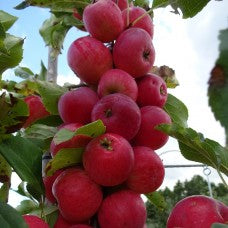
History: Kerr is an applecrab (cross between crabapple and apple) with Dolgo and Haralson parentage. It was developed at the Morden Research Station in Manitoba in the 1950s and named after plant breeder and ecologist William Les Kerr who was working at the station at the time.
Why We Grow It: The fruit is a pleasant dark red and unlike true crabapples, has a pleasantly sweet and tart flavour that makes it good for fresh eating. Although small, the fruit stores well and are quite juicy which makes them good for pressing. The juice does well when added to cider blends.

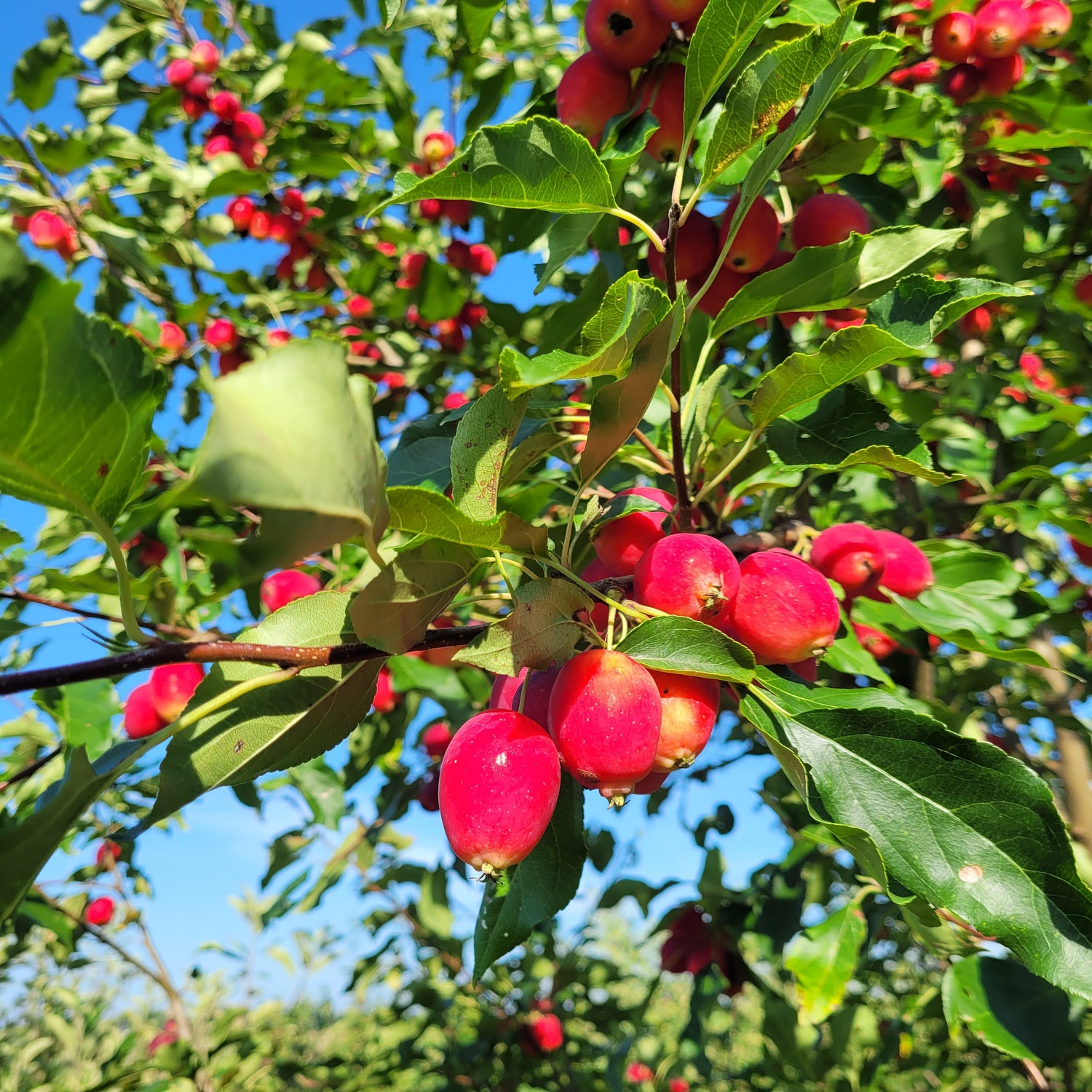
History: Dolgo is a variety of Siberian crabapple (Malus baccata) that originated in Russia. Due to the slightly elongated shape of the fruit, this variety was named 'dolgo' which means 'long' in Russian. They were brought to the United States by N. E. Hansen around 1897.
Why We Grow It: Dolgo is a classic crabapple with a vibrant flavour, very tangy and delicious right off the tree in the heat of summer- as refreshing as lemonade! The bright red fruits are about the size of small plums. These apples are excellent for making jelly or as a unique addition to a cider blend. Along with being exceptionally cold hardy, the trees themselves are quite pretty and are often planted ornamentally.
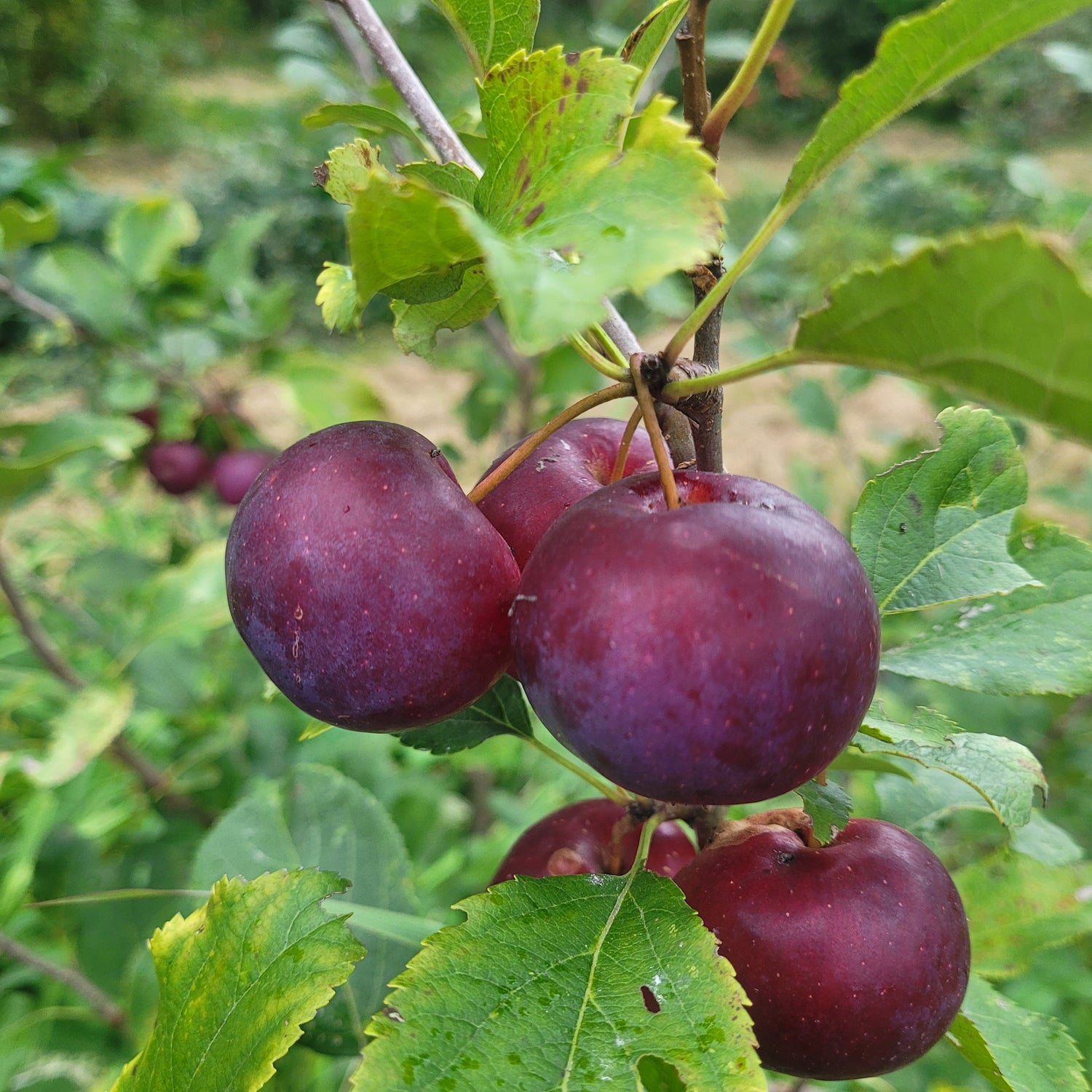
History: The exact origins of Hyslop are unclear but it was discovered sometime in the early 1800s around Boston by the Hyslop family who helped develop the area. This apple was popular for over a century but in recent years has fallen into obscurity.
Why We Grow It: Although definitely not recommended for fresh eating, Hyslop crabapples have a sub-acid, astringent flavour and are great in cider blends. They are also known as being one of the best apples for jellies. The tree is quite attractive with blue tinged blossoms in the spring and brilliant red/purple fruit in the fall.

History: Jonagold, a cross between Golden Delicious and Jonathan, was developed in 1953 at the New York State Agricultural Experiment Station at Cornell University. With its large size and sweet flavour, it has become one of the most popular apples in North America and is especially popular in Belgium.
Why We Grow It: The fruit is attractive with a red blush over yellow skin. It has a pleasant sweet-sour flavour that makes it a great multi-purpose apple.

History: Goldrush was bred specifically for scab resistance as part of the collaborative PRI disease-resistant breeding program run by Purdue University, Rutgers University, and the University of Illinois. It was developed in the 1970s and released in 1994. This variety has a complex heritage of Golden Delicious mixed with a cross of several other varieties for their disease resistance.
Why We Grow It: This is arguably the best scab-resistant variety released from the PRI Breeding Program as far as flavour is concerned. The dense, crisp flesh of this yellow apple is full of sugars and flavour. It is distinctly spicy and tart at first but mellows the longer it is in storage. The fruit stores exceptionally well. This truly multi-purpose apple is also great for drying and, unusually for a modern variety, is good in hard cider.
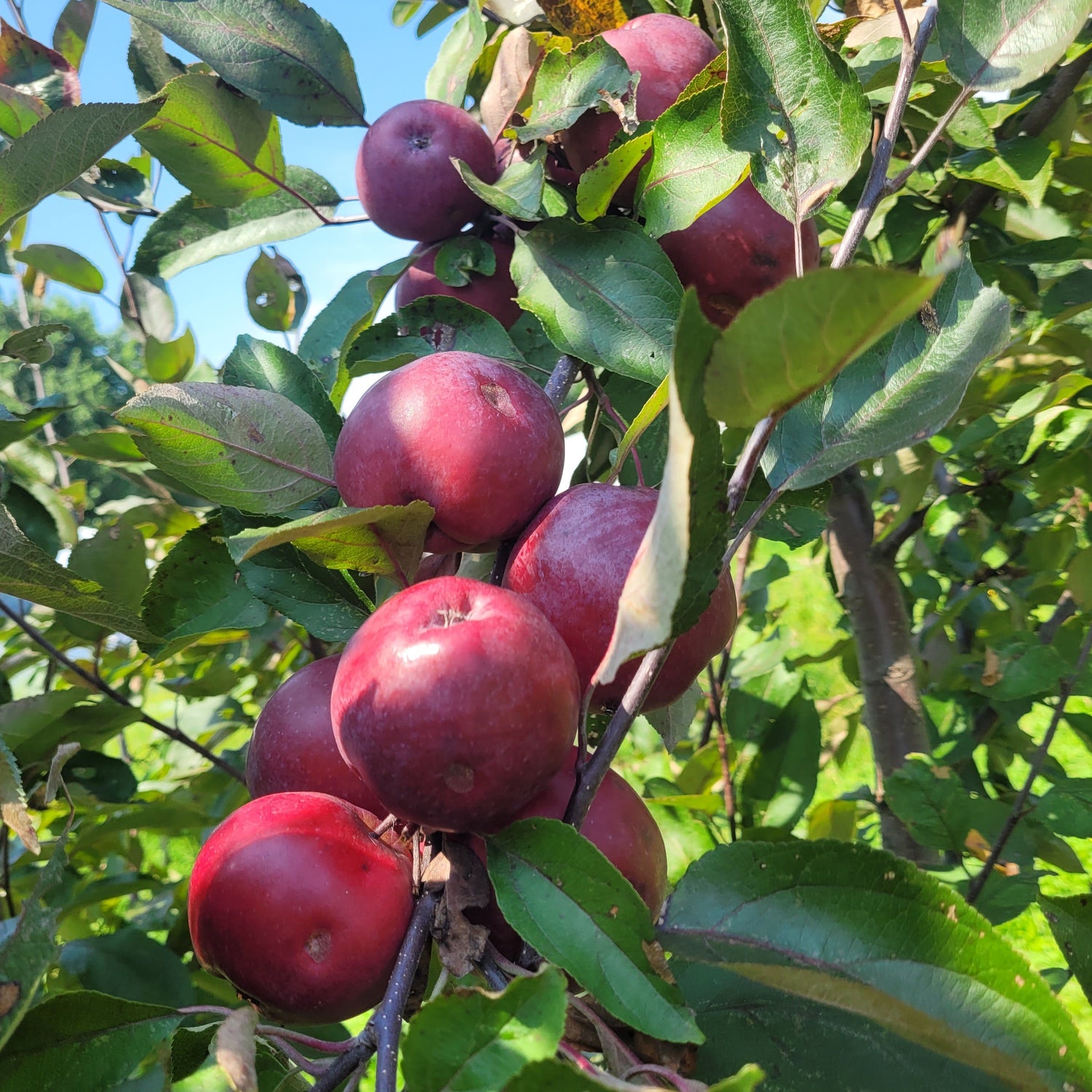
History: The Geneva crabapple was developed in the 1930s in collaboration with the Ottawa Experimental Farm and the New York State Agricultural Research Station based in Ottawa. The creation of this crabapple was head by Isabella Preston who specialized in creating cold-hardy ornamental plants.
Why We Grow It: This attractive crabapple has deep maroon flesh. The tree itself is quite visually appealing, sporting red leaves and bright pink flowers in the spring. The taste is reminiscent of rhubarb and is suitable for cooking as well. As it is a low sugar/high acid juice, it is best blended with another high sugar variety for cider. It also adds a nice red hue to blends.
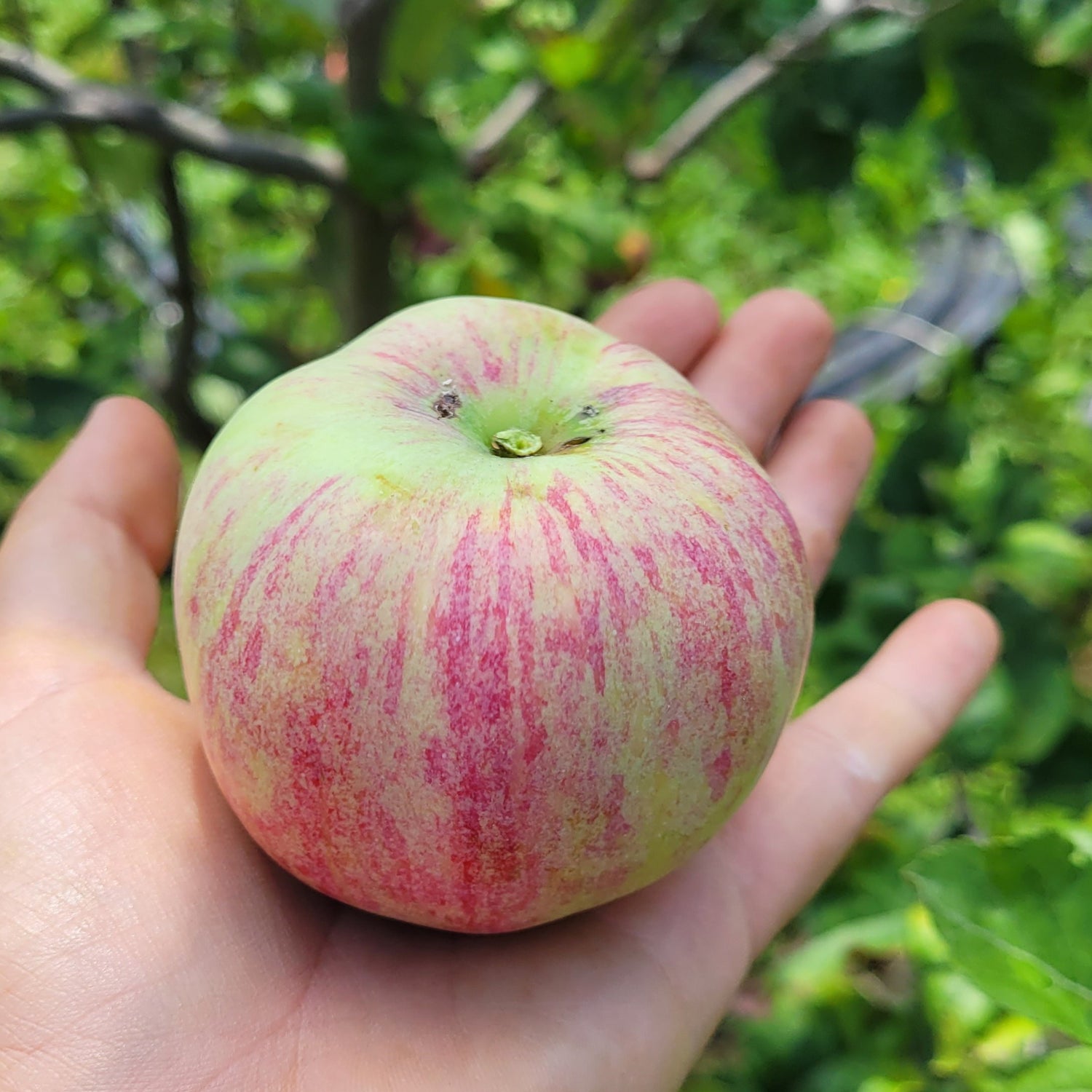
History: This cold-hardy apple was developed in the prairies and is for growing in colder, northern areas.
Why We Grow It: This unique apple produces a yellow fruit with red stripes. It is a rather uncommon variety and is great for sauce. It has begun producing reliably in our test orchard the last few years, and always has a bountiful crop.

History: Ginger Gold has quite the dramatic origin. In 1969 Hurricane Camille hit Virginia and brought awful floods, devastating the orchards of Clyde and Frances "Ginger" Harvey. As Clyde Harvey went to save the few remaining trees in his Winesap orchard, he discovered a mysterious seedling that produced yellow apples instead of red. Genetic testing showed it was a seedling of Golden Delicious, Albermarle Pippin, and an unknown third variety. Clyde named the variety after his wife and it was introduced commercially in 1982. Since then, it has become a commercially popular early variety! In 2007, the Virginia General Assembly proposed a bill to make Ginger Gold the official state apple, although this bill was sadly tabled.
Why We Grow It: It is easy to see why this such a popular early apple! Ginger Gold produces lovely bright yellow apples that sometimes sport a red blush. These medium-large apples have are firm and juicy with a pleasant sweet flavour that has a nice tart finish. The fruit is slow to brown which makes them even better for fresh-eating along with drying. For fans of feeding wildlife, Ginger Gold apples are known to hang onto the tree well after they are ripe.
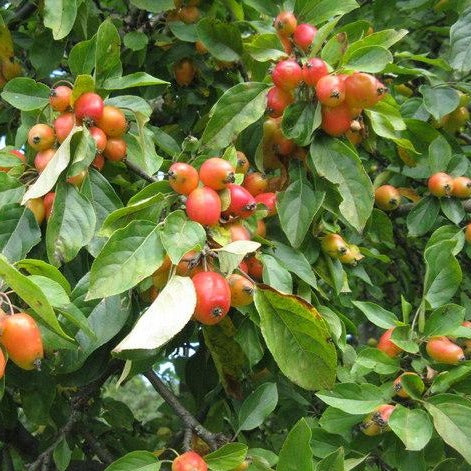
History: John Downie was raised by Edward Holmes, a nursery worker in England, in the 1870s. The variety was named after another nursery worker and friend of Holmes, John Downie. John Downie crabapples remain one of the most popular of the English crabapples.
Why We Grow It: This crabapple sports bright orangey-red fruit, often used to create some of the best jelly around. With its sweet-tart flavour, this crabapple can be pressed into a cheery orange juice that is a great addition to cider blends.

History: Hewe's Virginia (aka Hughes' Virginia or Virginia) was discovered in Virginia in 1817 although the first trees discovered were thought to be around 100 years old. It is believed that Hewe's Virginia is a cross between a European apple and a North American crabapple. It became quite popular for its excellence as a cider apple and was favoured by Thomas Jefferson who devoted an entire block of his orchard at Monticello to just Hewe's Virginia. This variety was widely planted in the 18th and 19th centuries but waned as interest in cider-making declined. Luckily, it stuck around with us due to its usage as rootstock and pollinizers for other varieties. With the growing popularity of cider in the US, however, Hewe's Virginia is making a strong comeback as people are once again realizing its potential.
Why We Grow It: This hardy, vigorous tree produces a good number of crabapples that are excellent for cider. It is easy to see why this variety was so popular back in the day and is making a resurgence now, the bittersharp juice is great on its own and in blends. Hewe's Virginia is also great for making jelly!
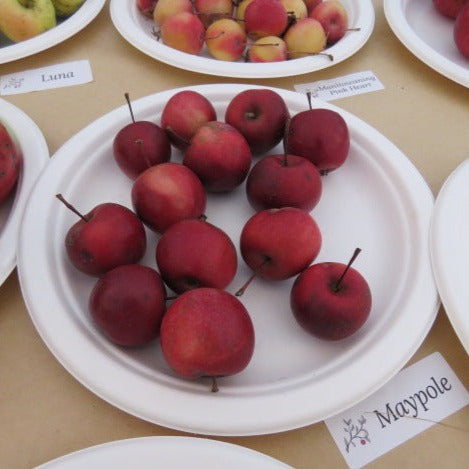
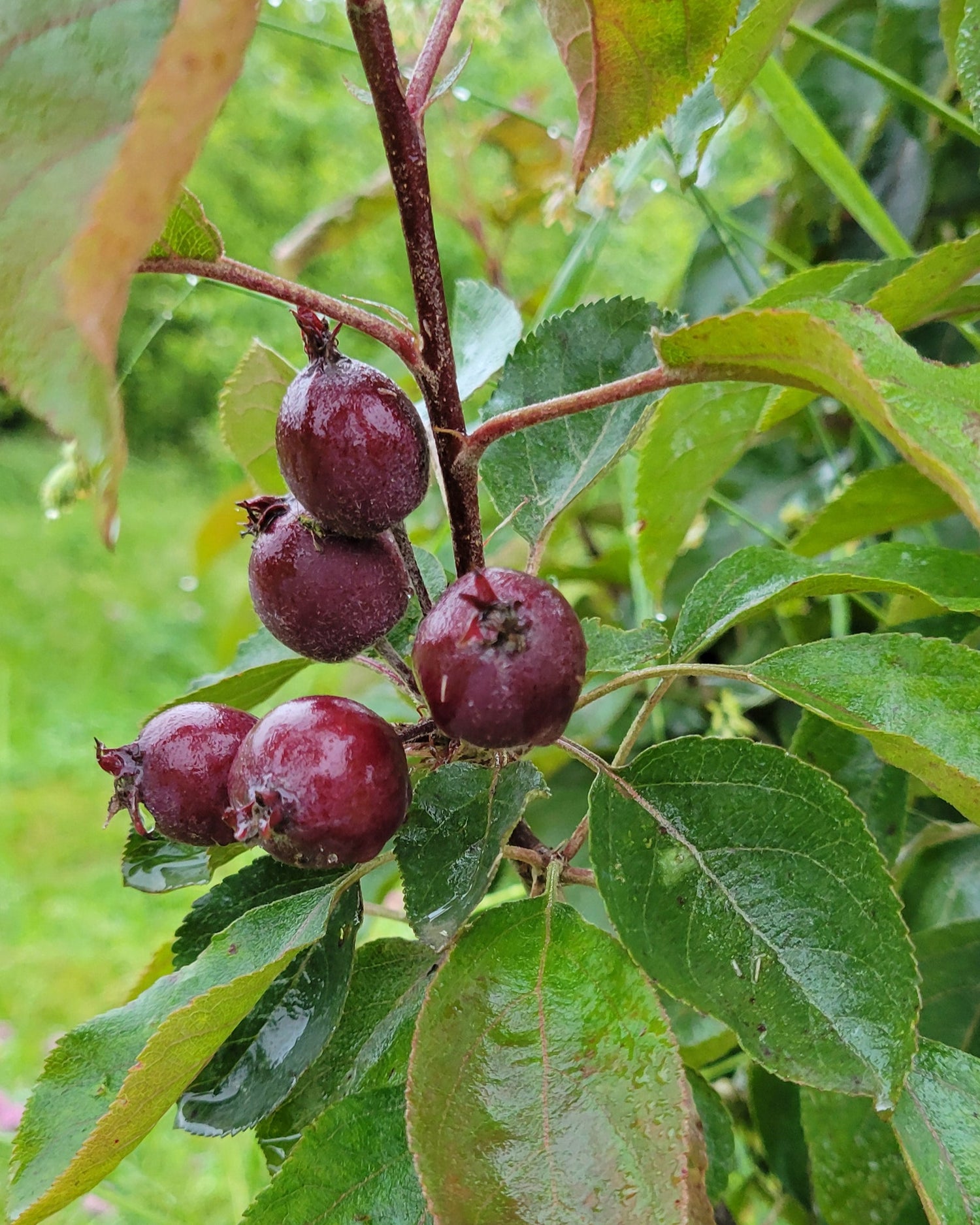
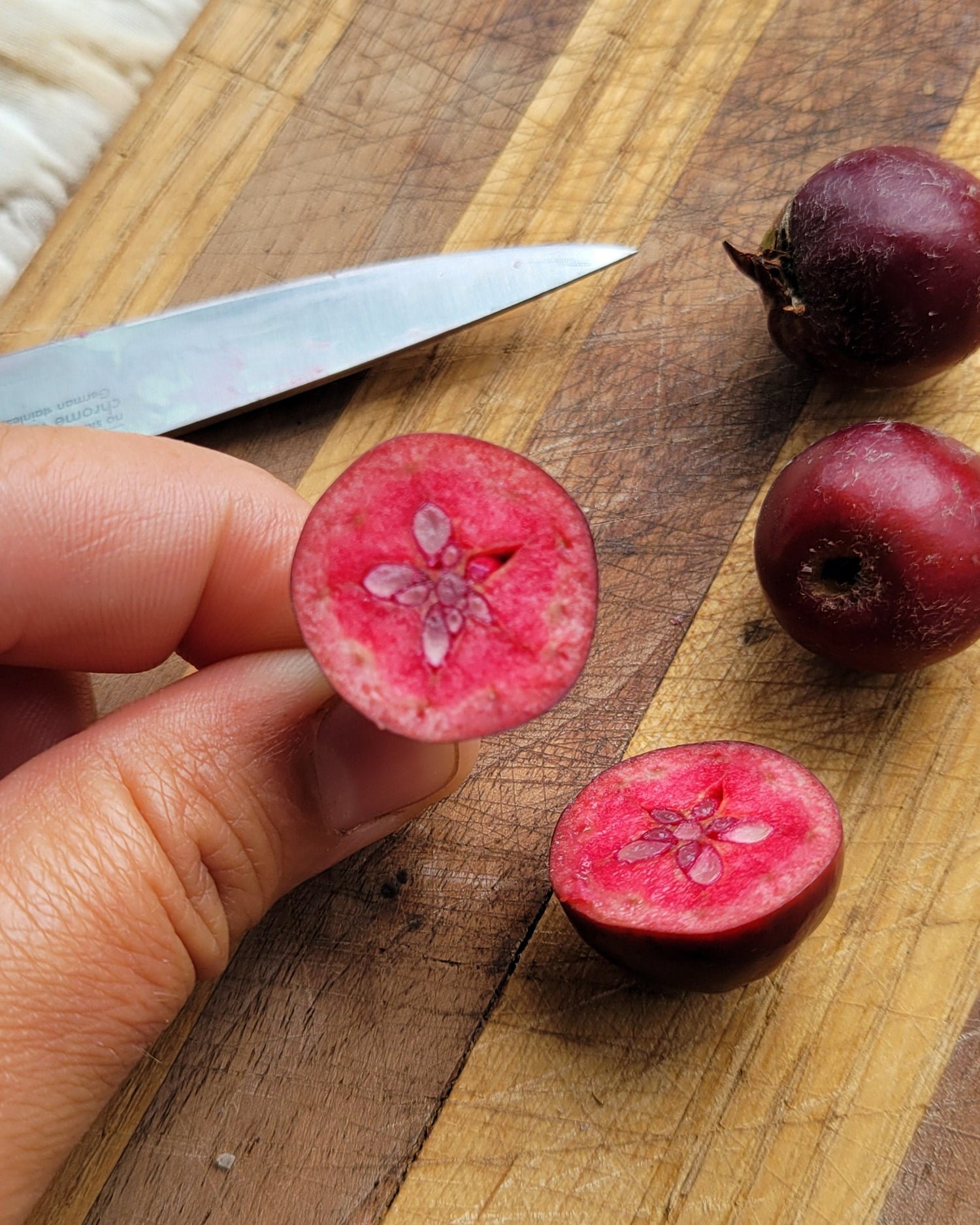
History: Maypole was developed in 1976 by Plant Breeding International at the East Malling Research Station in the UK as a cross between Wijcik Spur McIntosh and Baskatong. Wijcik Spur McIntosh originated as a mutation discovered on a McIntosh tree in 1962 in the Wijcik Orchards in British Columbia, the branch growing oddly straight with little branching. Several varieties were deliberately bred to have this mutation and now Maypole, released in 1986, is one of six columnar varieties developed at the station. This series of trees is known as Ballerina in the UK but due to that name being unavailable in the US, they are known as Colonnade in North America.
Why We Grow It: Not only is Maypole unique as a columnar apple, this crabapple also boasts lovely red flesh, bronze coloured leaves, and pretty pink blossoms in the spring. This makes it overall a lovely ornamental tree to have, whether planted in the yard or in a pot. The fruit is also excellent for jelly, apple butter, and cider, adding a red hue to each. It can also be eaten fresh although it tends to be quite acidic with a touch of sweetness.

History: Glowing Heart was bred in Toronto by Fred Jansen, one of the founders of the North American Fruit Explorers (NAFEX). This unique apple is still in its early years.
Why We Grow It: This variety has a unique pink and white flesh and is quite acidic. One bite will make you pucker! Although not the best option for fresh eating, this apple creates an aromatic jelly with rich flavour and can be used in ciders as well. It does well in organic orchards.
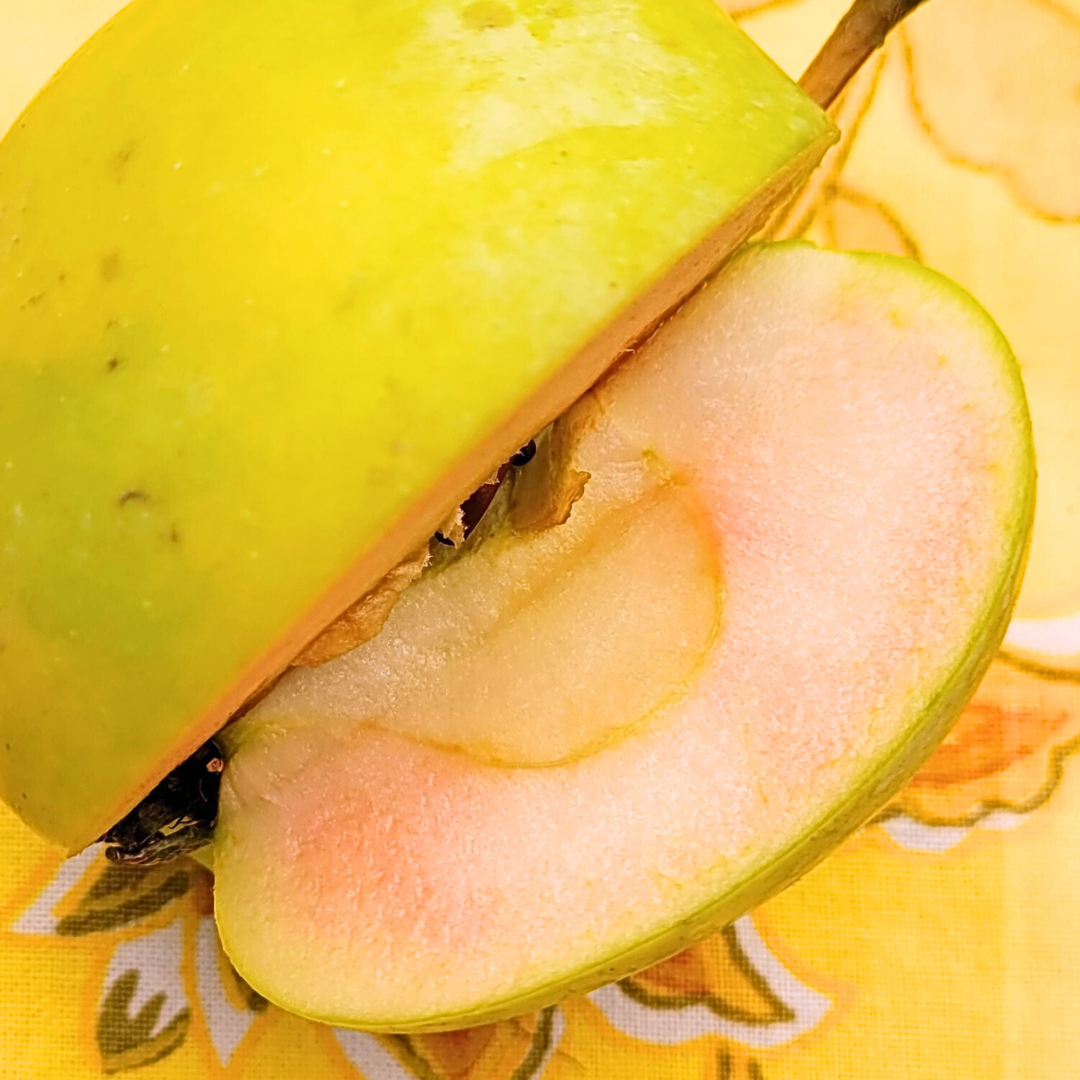
History: Airlie's Red Flesh originated on the farm of Lucky and Audrey Newell in Airlie, Oregon who sold the property in the 1960s. Two decades later in the 1980s, a Louis Kimzey was walking through the old orchard, bit into an apple from the tree, and was amazed at its stunning pink flesh. This was also known as Newell-Kimzey to reference those who found it and Airlie's Red Flesh as a reference to its place of origin and pink flesh. It also goes under a separate brand name.
Why We Grow It: This small, slightly conical apple has yellow skin that belies a bright pink interior that whitens near the core. Not only is it pretty, the fruit has a very sweet flavour with some mild astringency and the flesh is slow to brown. Along with the attractive fruit, the tree boasts bright pink blossoms that gives it an extra ornamental appeal.
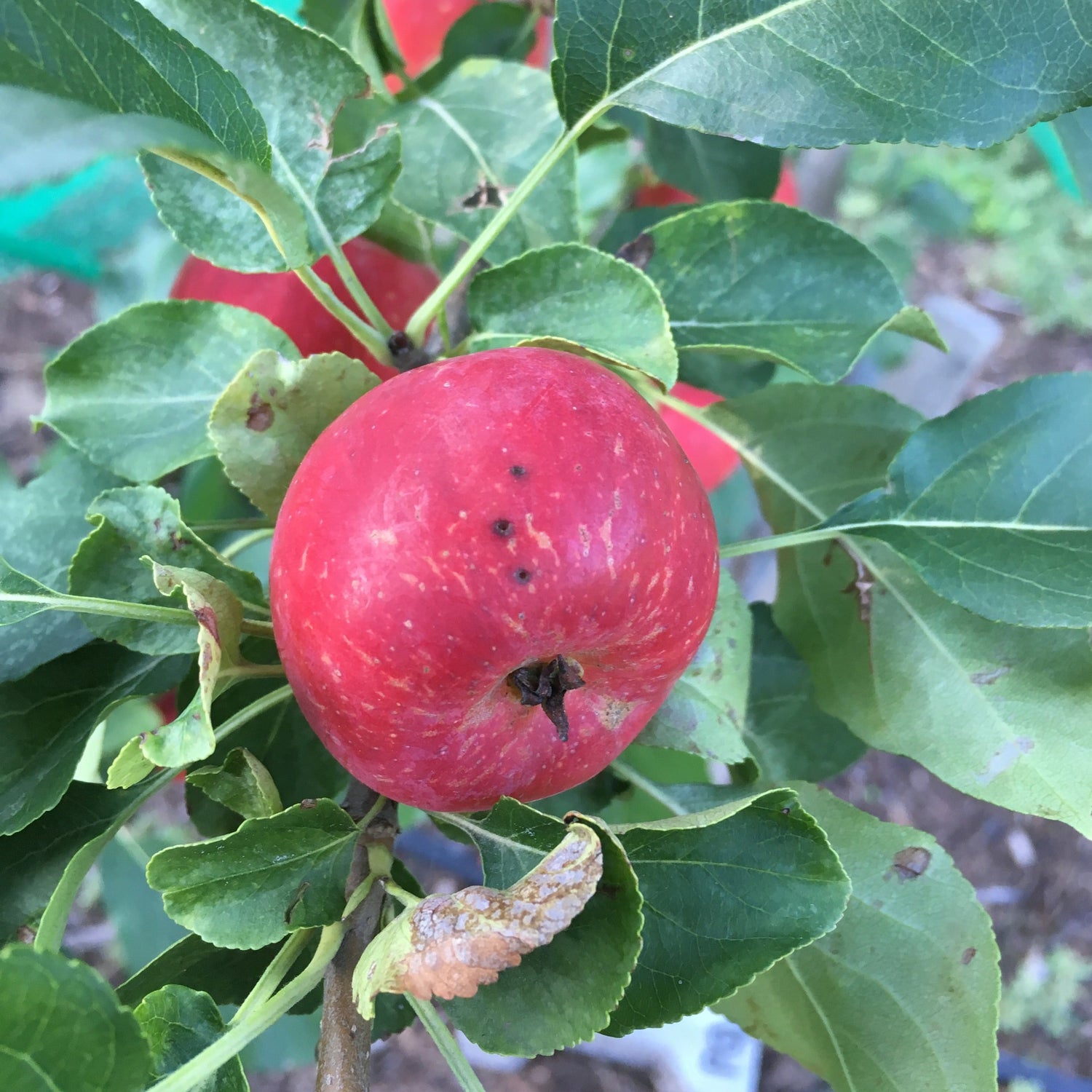
For the most up-to-date information see Claude Jolicoeur's website here!
History: This particular iteration of Trail, previously referred to as Bilodeau, has a bit of a messy history. A Trail crabapple tree was mislabeled at a Quebec nursery in the 1980s and sold to an unknowing customer named Claude Bilodeau who thought he was purchasing a pear tree. Later on Claude Jolicoeur, well-known Quebecois cider-maker and pomologist, took a cutting from this tree and found that the fruit (definitely not a pear!) was excellent for making cider. Since it was still a mystery what the original variety was, the crabapple was named Bilodeau by Jolicoeur after the owner of the tree - only for Paul Kron from the University of Guelph to confirm that it was actually Trail via DNA testing in 2022. The Trail crab was bred at Ottawa from a cross of Northern Queen x Rideau, it was selected in 1913 and introduced in 1920.
Why We Grow It: Despite the confusion, we are regardless happy to have this apple in our catalogue! This bittersharp cider apple has excellent cider-making qualities and, unlike most crabapples, is also great when eaten fresh or made into jelly!
History: Whitney crabapples were grown from seed by nurseryman A.R. Whitney around 1865 at Whitney Nursery in Illinois, US. It became popular for its excellent cold hardiness and productivity and in the 1900s the state of Montana recommended it as one of the best crabapple varieties to grow.
Why We Grow It: These large (for a crabapple) yellow and red apples boast a sweet-sharp flavour with some astringency and juicy, crispy flesh. They are a truly multipurpose fruit and can be eaten fresh (if you like some astringency to your apple) or used for cooking, sauce, cider, and jelly. The trees are very cold hardy and boast good disease resistance as well.

Why We Grow It: It is easy to see why growers were so eager to overlook Viking's scab susceptibility, its flavour providing a sweet-tart taste with notes of rose and lychee. It is an excellent all-purpose apple that can be used for cooking, baking, sauce, and cider. Its great flavour and utility is matched by its attractive appearance, the large fruit featuring dark red skin bordering on maroon. However, it does bruise easily and brown quickly and only stores for about a month at most.

History: Paula Red (sometimes written Paulared) was discovered in Michigan in 1960 by Lewis Arends near a ravine where apples were dumped. It was one of several wild apple seedlings that had sprouted up from the discarded seeds. Likely pleased by its attractive red skin and flavour, Arends named it 'Paula Red' in honour of his wife Pauline. It is a cross between Duchess and McIntosh.
Why We Grow It: Paula Red produces medium to large red apples with small yellow/green patches that are juicy and firm with a nice sweet/tart flavour. The flavour has strong vinous and strawberry notes. It is also slower to brown. This early-ripening variety tends to soften relatively quickly which means it does not store very long, but it is great for making applesauce. The tree produces heavy crops although tends to bear every other year as a result.

History: York Imperial was discovered as a seedling tree growing on the farm of John Kline in Pennsylvania. Nurseryman Jonathan Jessop, of Springwood Farm in York, Pennsylvania, began propagating the variety in 1820 after witnessing schoolboys digging through the leaves around the base of the tree in spring and retrieving apples there were in great condition despite spending all winter on the ground. In an age without refrigeration, Jessop knew this variety had excellent commercial potential. It was initially named Jonathan's Fine Winter for its excellent storage properties but was later renamed York Imperial after horticulturalist Andrew Jackson Downing called it the 'imperial of keepers,' again referencing its storability and the location of Jessop's farm. It quickly became popular and remains one of few heritage apples that are still commonly grown in the US today.
Why We Grow It: York Imperial produces a rather lop-sided fruit with yellow skin and red striping. It is crisp and juicy with a lovely sweet, honeyed flavour that is hard to turn down. The fruit is truly all-purpose, also being great for cooking, baking, jelly, juice, drying, and cider and generally storing quite well. While not the fastest growing tree and with a tendency to start producing fruit a little later than other varieties, York Imperial is an exercise in patience that is well worth the wait.


History: While on vacation on Manitoulin Island in 2022, Wayne Kuntze found Manitowaning Pink Heart growing wild in the corner of the Gulyas family's yard and (with permission) brought the apples and some grafting material back to Silver Creek Nursery. The distinct pink colour and the heart shape of the fruit caught his eye, along with the pink flesh inside. Fittingly, he named it Manitowaning Pink Heart after the village where the property was located and the unique appearance of the apple. A truly unique variety, we are happy to officially introduce it in 2023!
Why We Grow It: We love unusual apple varieties and Manitowaning Pink Heart really stands out! With its attractive pink blush over yellow skin, pink flesh, and heart-shaped fruit, this is a one of a kind apple! Despite its sweet appearance, this crabapple is quite tart and tannic. Like other crabapples, this one is best suited for jelly and cider. Its pink flesh may help add a distinctive colouration.
This is a brand new variety and we're still learning about it! For any avid apple growers who decide to plant these out, feel free to keep us updated on how it grows, what you use the fruit for, etc, so we can provide as much information as possible!
Bloom photo courtesy of Christine Gulyas
History: Arkansas Black originated, as its name implies, in Arkansas sometime in the mid to late 1800s although there are conflicting opinions on who exactly discovered it. Some say John Crawford developed it in the 1840s, others believe DeKalb Holt developed it at his brother's nursery in the 1870s, and another account claims John Braithwaite found it growing in his orchard. Regardless, this unique looking apple eventually became the most popular apple in the state until a bad codling moth infestation followed by the Great Depression devastated commercial orchards. Despite this heavy blow, it is still a popular apple in backyards and small-scale orchards.
Why We Grow It: Arkansas Black produces a unique fruit that is a dark purplish-red that at times almost looks black. Fresh off the tree the fruit is hard and fairly acidic, but it softens and sweetens in storage and develops a more pronounced spiced flavour. It is good for pies, sauce, and cider and the fruit stores quite well! The tree itself is fairly disease resistant as well.


History: Waxing Moon was discovered by Steph's cousin Liam Younger who has spent many summers working here at the nursery! He found it growing as a chance seedling on his family farm in 2023, drawn in by the apple's pale white skin. Naming the variety Waxing Moon for its moon-like appearance, he grafted a small number of the trees here and we are happy to introduce the variety in 2024!
Why We Grow It: Waxing Moon produces an exceptionally pale yellow apple that is nearly white! While one would think it is a Yellow Transparent apple, its mild sweet flavour lacks any of the tartness. Like Yellow Transparent, this variety is good for fresh eating and sauce. It appears to be relatively disease resistant, having produced clean fruit with no care whatsoever.
Since this is a new variety, there is still a lot for us to learn about it! If you grow this variety and have any observations or find any fun uses for the fruit, we'd love to hear from you!

History: Mindemoya Maroon was discovered near Mindemoya, Ontario by Wayne Kuntze when he was vacationing on Manitoulin Island with his family in 2020. It, along with Mindemoya, were found growing wild along Lake Mindemoya. It was named for the location where it was found and the red flesh of the crabapple. We are happy to officially introduce this variety to the world in 2023!
Why We Grow It: Always excited to try new things, Mindemoya Maroon is hard to turn down with its bright red flesh. For those who like really tart apples, it is not bad for fresh eating but would likely be better for jelly or potentially cider. Red-fleshed varieties often produce a lovely red juice, adding visual appeal to whatever they're used in!
This is a brand new variety and we're still learning about it! For any avid apple growers who decide to plant these out, feel free to keep us updated on how it grows, what you use the fruit for, etc, so we can provide as much information as possible!

History: Delbarestivale was developed by Delbard, a nursery in France, in the 1950s. Likely named as a portmanteau of 'Delbard' and 'estivale' (translated from French as 'summer') due to its early ripening time, this variety goes by many other names including Delcorf, Monidel, Dalili, and Ambassy. It was bred in an attempt to create an improved version of Golden Delicious. Although not quite as popular as Golden Delicious, it is still grown commercially in parts of France and England and the Royal Horticultural Society awarded it the Award of Garden Merit in 1998.
Why We Grow It: This French apple is very sweet but balanced nicely with a sharp flavour. The flesh is aromatic and crisp and the skin is a lovely, stripey bi-colour with reddish streaks overlaying green. The apples store quite well for an early-ripening variety, although they do tend to bruise easily.

History: Goodland was developed at the Morden Research Station in Manitoba as part of an effort to breed cold hardy apples for the prairies. It is a seedling of Patten Greening that was selected in 1925 and the variety was introduced commercially in 1955.
Why We Grow It: The cold hardy Goodland produces a medium to large yellow apple with red striping. This crisp, juicy apple has sweet/tart flavour that is great for fresh eating, cooking, and sauce. Unlike most early ripening varieties, Goodland will store well for several months.

History: Rescue was developed at Agriculture and Agri-food Canada's Scott Research Station in Scott, Saskatchewan and was released in 1933. It is an open-pollinated seedling of Blushed Calville.
Why We Grow It: Although the fruit is on the smaller side and doesn't keep well, Rescue has a good sweet-tart flavour that is good for fresh eating and is also good for cooking and preserves. This cold hardy applecrab is an excellent pollination partner for other apple trees.

History: Harcourt was developed by the University of Alberta and released in 1955. It was named after George Harcourt, a key player in the creation of the university's agricultural program, in honour of his legacy in shaping Albertan agriculture as a professor, civil servant, and horticulturalist.
Why We Grow It: This cold hardy variety produces apples that are lightly waxed with prominent red striping. The fruit is crisp and juicy with a pleasant sweet-tart flavour. Harcourt apples do need to be enjoyed quickly since, like many early-ripening varieties, they do not store well. Fortunately, they are great for juice, sauce, and drying!

History: Scarlet Vivian was originally an urban wild tree found by Wayne in 2018 and has been grown by Silver Creek Nursery's previous owner Ken Roth. It is likely a cross between a crabapple and an apple. We are excited to introduce this new variety in 2023!
Why We Grow It: Scarlet Vivian is quite similar to Dolgo although a little larger. For those who like very tart apples, this is an excellent one for fresh eating! The flavour is rich and complex, but balanced enough that it is quite enjoyable. However, Scarlet Vivian is best made into a jelly where its red colouration really shines. It may also have potential in cider blends. Based on Ken's observations, the tree appears to be relatively free of pest and disease issues.