Fresh Eating Apples

Fresh Eating Apples
Malus domestica
This collection highlights all of the apple varieties we offer that are great for fresh eating. Remember, everyone's palate is a little different, and some of you might love a more sour or bitter apple which may not be in this collection. Don't let that stop you from growing and eating those apples too! If you love a good pucker, consider checking out our Cider apples and Crab Apples as well as the tasty options below.
We offer flat rate shipping across Canada for our bareroot apple trees!
134 products
Sort by:
134 products
134 products

History: Jonathan has an interesting history since there are two potential origins. One story says that Rachel Higley collected apple seeds from the local cider mill which she later grew on her new property in Ohio in 1796. She named one of the new varieties Jonathan after a young boy who often visited her orchard. The second, and more likely story, is that it was grown by farmer Philip Rick in the 1820s in New York. Originally named Rick, the apple was renamed Jonathan after the man who brought it to the attention of the Albany Horticultural Society.
Why We Grow It: These cheery red apples are crisp, juicy, and sweet. They are good for fresh eating as well as turning into pies and sauce. The fruit also stores quite well, lasting until January/February under optimal conditions.

History: Westfield Seek-No-Further was discovered in Westfield, Massachusets in the 1700s. Its flavour is reminiscent of popular fresh eating apples in England which is probably why this apple was so popular among English colonizers. It was the most popular fresh eating apple in New England during the 1800s.
Why We Grow It: Historically a favourite eating apple, Westfield-Seek-No-Further's sharp, nutty flavour is as unique as its quaint name! It now has potential as an addition to cider blends.

History: Rouville apples were created by R.L. Granger and G.L. Rouselle in 1962 at the Agriculture and Agri-food Canada research centre located in St.-Jean-sur-Richelieu, Quebec. The variety was introduced in 1983.
Why We Grow It: This lovely Quebec cider apple has a wonderful bitter-sweetness that is great for fresh eating and juicing and sauce. It is resistant to scab and has grown very well in our test orchard.


History: Prima is one the apples developed from the collaborative PRI disease-resistant breeding program run by Purdue University, Rutgers University, and the University of Illinois. It was introduced in 1958 but unfortunately is no longer fully scab resistant due to the fungus evolving to overcome the resistance since then.
Why We Grow It: Another great apple for organic production and excellent for the backyard or farmer’s market sales! This apple is sweet, juicy, and flavourful and boasts good disease resistance..

History: Discovered in New Zealand by farmer O. Moran in 1952, Braeburn took the world by a storm, becoming one of the most popular commercial apples in the United States and parenting many modern cultivars such as Jazz and Sweetie.
Why We Grow It: Its winning sweet-tart flavour wrapped in an attractive orangey-red skin makes it an excellent fresh eating apple. It is firm and holds its shape well when cooked, and keeps about 4 months. This variety is fairly disease susceptible, meaning it is better for the experienced natural grower or conventional orchards. It is moderately vigorous and a heavy cropper.

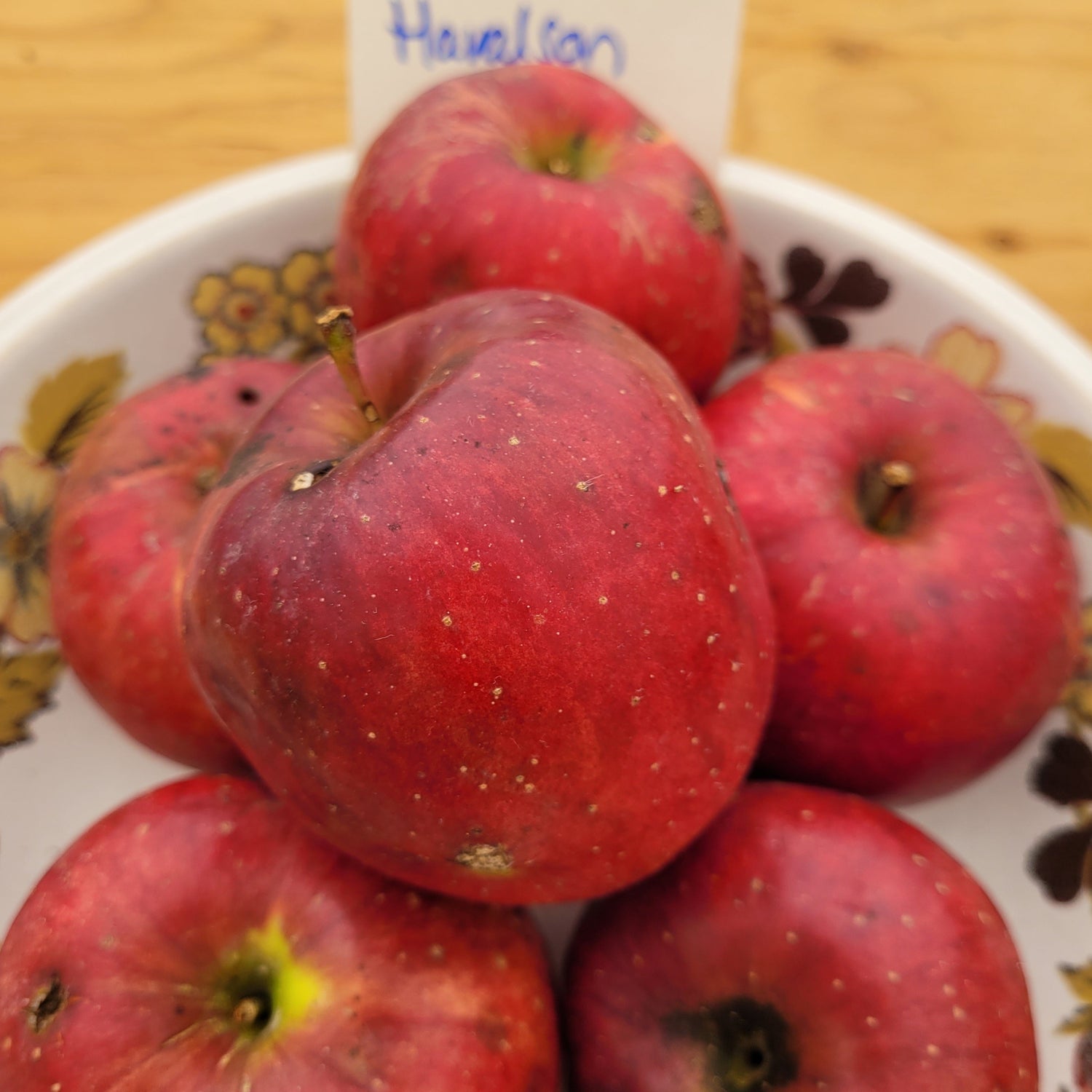
History: Haralson apples were developed at the University of Minnesota in 1922 and named after Charles Haralson who was superintendent of the university's fruit breeding farm. It is one of almost 30 apple varieties the university has developed in its breeding program since it began in 1888.
Why We Grow It: The skin of this variety is striped red with russet dots and the flesh is white, juicy, and of pleasant albeit mild flavour. Haralson boasts excellent cold hardiness and general disease resistance.

History: Antonovka was discovered near Kursk, Russia in 1826 and then developed by renowned Russian plant breeder I.V. Michurin. It was released in 1888 and became a popular variety in Russia, Poland, and Belarus due to its good flavour and quality for cooking/baking. In Russia, Antonovka was given the name 'The People's Apple' and in 2008 a monument to it was unveiled in Kursk. Although this hardy variety is less popular outside of its homeland, it has been commonly used as rootstock due to its ability to grow a strong, deep root system that makes it hardier and more drought tolerant.
Why We Grow It: This tree produces a refreshing, juicy, tart yellow apple that cooks down well. It is also quite cold hardy which is a great feature in our Canadian environment.

History: Maiden's Blush was first described in New Jersey in 1817 although it had already been popular in Philadelphia markets for some time. It likely originated around New Jersey in the late 1700s. Maiden's Blush continued to be commonly grown in the southern US through the early 1800s.
Why We Grow It: Maiden's Blush's uniqueness is still worthy of attention today, its flavour being an interesting mix of citrus-like acidity and sweetness that stand out among other apples. While it is good for fresh eating, particularly after a few weeks off the tree, it is most well known for cooking, baking, and drying due to its non-browning qualities.

History: Elstar apples were developed in the Netherlands in the 1950s and are a cross between Golden Delicious and Ingrid Marie. This excellent combination has created what is considered one of the best Golden Delicious offspring. Fittingly, it has since become quite popular in continental Europe. Despite being introduced to the US in 1972, it has not attained the same level of popularity in North America.
Why We Grow It: Elstar is a flavourful variety, fine for fresh eating or sauce with its crisp, juicy flesh; very little acidity. The skin is distinctive, sporting a orangey-red marbled appearance.
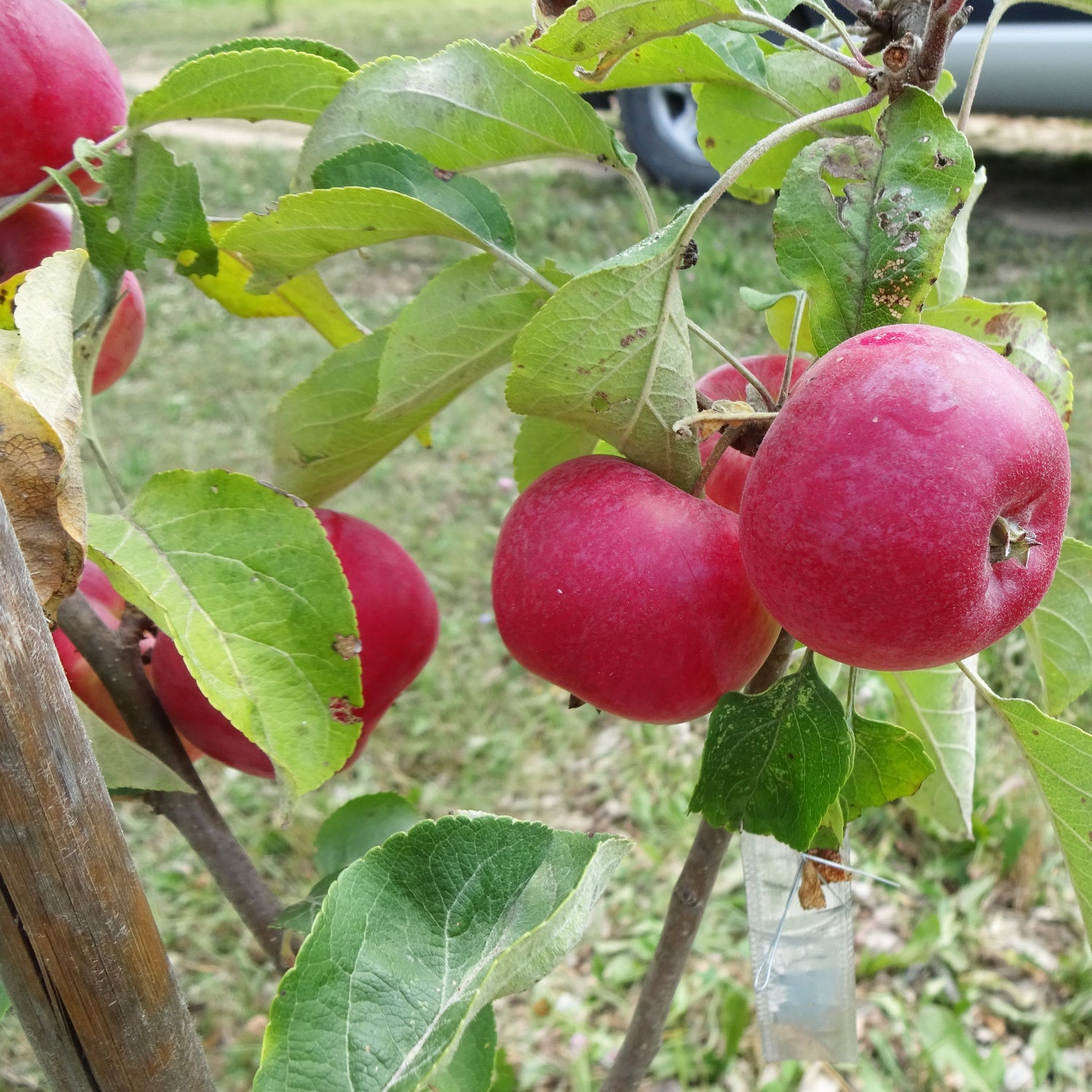
History: Parkland apples were variety created at the Morden Research and Development Centre in Manitoba and released in 1979. Like other varieties developed there, Parkland was designed to withstand the harsh prairie winters and is especially cold hardy. It has become the most commonly grown apple in Alaska after it was brought over in 1985 in an effort to determine which Canadian varieties could survive in the northern state.
Why We Grow It: Parkland is a very satisfying early season apple - sweet and crunchy. It's excellent snacking or applesauce although the fruit is small (about 2" diameter) with creamy flesh and red skin. The tree is quite hardy.


History: Priscilla is the second apple variety developed through the collaborative PRI disease-resistant breeding program run by Purdue University, Rutgers University, and the University of Illinois. It was planted in 1962 and has a complex heritage that includes Starking Delicious, McIntosh, Golden Delicious, and Rome Beauty. It was introduced in 1972 and named 'Priscilla' after Priscilla Hovde, the wife of the seventh president of Purdue University as it happened to fit the 'pri' naming scheme for the varieties developed through the program.
Why We Grow It: Another successful introduction from the PRI breeding program, Priscilla boasts resistance to most common apple diseases including fireblight and scab. The fruit is also quite attractive with a deep red blush over yellow skin with a sweet and subacid flavour.


History: Redfree is one of the apples developed under the collaborative PRI disease-resistant breeding program run by Purdue University, Rutgers University, and the University of Illinois. It was bred in 1966 and officially introduce to the public in 1980.
Why We Grow It: Redfree apples are great for fresh eating with a pleasant, mildly sweet flavour and softer yet crisp flesh. The fruit does not ripen all at once, allowing a longer eating season. As its name would suggest, it has decent resistance to several common apple diseases.

History: Shizuka (translated as "quiet" or "calm") was created at the Aomori Apple Experiment Station in Japan in the 1930s. It is a cross between Golden Delicious and Indo, the same parentage as its sister apple Mutsu.
Why We Grow It: Although it resembles Mutsu with its large yellow-green fruit, sometimes featuring a reddish-orange blush, Shizuka is sweeter and less acidic. This is an excellent fresh-eating apple for farm gate sales and it also keeps well. It is also great in salads due to its slow browning.

History: Wagener apples come from a seed that was planted by George Wheeler in the Finger Lakes area of New York in 1791. In 1796, Abraham Wagener purchased Wheeler's property and planted the seedling on his own property in Penn Yan village where the tree was known for producing attractive, tasty fruit in abundance every year. The variety was named after Wagener and became popular for its excellent storage qualities.
Why We Grow It: Wagener is ideal for the self-sufficient homesteader who values a late keeper, lasting until April in an ordinary cold cellar. When first picked they have a sharp, acidic taste and are great for cooking. In storage, they mellow to an excellent sweet, crisp apple that is perfect for fresh eating.


History: Generally just known as Gravenstein, it is unknown when or where exactly these apples came from but they were imported from France to Denmark in the 1600s by Count Frederik the Younger and planted at the summer residence of the Danish royal family, Gråsten Palace. As a result the variety was named Gråsten (Danish for graystone) which translates to Gravenstein in German. This apple has been popular in Canada since the 1820s, particularly in Nova Scotia, and provided the dried apples and applesauce for American soldiers during WW2. In 2005 it was declared the national apple of Denmark.
Why We Grow It: Yellow Gravenstein's excellence as a fresh eating and cooking apple makes it easy to see why it is grown in so many different countries, even if the tree is slow to bear fruit and is prone to many common fruit tree diseases (although we haven't had much issues growing it here). It has a great sweet/tart flavour and is crunchy and juicy. The fruit is a nice yellow with red striping.

History: Lady apples are one of, if not the oldest, apple varieties in existence with a verifiable history. It is said to have originated in the Brittany region of France before 1628 and was grown during the reign of King Louis XIII. This apple goes by several other names as well. It is also known as Api or Pomme d'Api, named after the Forest of Api in France where it is believed this apple may have been discovered. This particular name is similar to Appia, an apple variety popular in Ancient Rome, which some believe is the same apple as Lady. Lady apples are also known as Christmas apples due to their use in adorning Christmas wreaths and trees.
Why We Grow It: It's hard not to be interested in an apple with such a long history as this one. The fruit is small but attractive: red flushed over yellow. The crisp, sweet fruit maintains its good quality all winter in storage.
History: Norhey comes from the Morden Research Station, Agriculture Canada. It was created by Dr. C. R. Ure in the 60's to survive the harsh prairie winters. It was introduced in 1975.
Why We Grow It: It seems Dr. Ure was successful since this is about the hardiest apple we've come across. The fruit has green skin that turns yellow after picking. It's fair for fresh eating, good for cooking and juicing with sweet, sub acid flavours and creamy crisp flesh. The tree has consistent, heavy crops.
History: Westland apples were developed at the Alberta Special Crops and Horticultural Research Centre in Brooks, Alberta and introduced in 1979.
Why We Grow It: This medium sized pie apple is cold hardy, excellent for the prairies and northern regions. The fruit is large and a pale yellow-ish green with red flush and stripes.


History: This apple was developed in New York in 1974. It has never achieved major popularity but remains a curiosity due to the deep red colour of its skin which causes the flesh inside to become stained pink.
Why We Grow It: Along with its visual appeal, this apple boasts a sweet, sub-acidic flavour that makes it suitable for both fresh eating and making cider. Although these apples don't store well, the fruit hangs onto the tree for three weeks which helps to keep it available a little longer.
Picture of Burgundy apples on the tree courtesy of Shannon McInnis

History: Vista Bella was created at Rutgers University in New Jersey in the 1950s and released in 1974. Although its poor keeping ability prevents it from being a commercial success, this early ripening variety is still a nice way to herald in the apple harvest season every year.
Why We Grow It: Vista Bella is the first red apple of the season. The flavour and texture are of better quality than other early apples, making Vista Bella an excellent choice for early farmer’s market sales and roadside stands. The flesh is crisp and juicy, although it softens quickly and, like other early apples, does not keep long.

History: Fallawater originated in Pennsylvania sometime before 1842, possibly from seeds brought by European colonizers. At one time it was quite popular in the southern United States. This variety has over twenty different names, many of which resemble Fallawater such as Fallenwalder, while others are more fun and unique like Molly Whopper, Green Mountain Pippin, and Prim's Beauty of the West.
Why We Grow It: No matter which name this variety goes by, you can always expect a large, attractive apple with a mildly sweet flavour. Fallawater is an excellent sauce and cooking apple and the fruit stores for a long time.


Why We Grow It: Although it failed to take off commercially, Silken is an excellent early fresh-eating apple. It is attractive with pale yellow skin sometimes with a faint pinkish blush. The fruit has crisp, juicy flesh that is quite sweet with a little bit of acidity. The tree grows quickly and tends to start bearing fruit at a young age.

Why We Grow It: Along with the great sweet flavour and juiciness of the original, Fuji BC #2 also boasts redder skin, making it more appealing for those who prefer red apples.


History: This McIntosh type apple was developed in New Jersey at the Rutgers Agricultural Experiment Station in 1956. It was released commercially in 1971.
Why We Grow It: For McIntosh lovers this is a great apple to grow since it ripens before actual McIntosh apples. It is a bit more tart than McIntosh which makes it great for cooking, baking, and applesauce. It is recommended to use a thickener when baking pies since the flesh cooks down quickly. This tree is also a good cropper.

History: Ginger Gold has quite the dramatic origin. In 1969 Hurricane Camille hit Virginia and brought awful floods, devastating the orchards of Clyde and Frances "Ginger" Harvey. As Clyde Harvey went to save the few remaining trees in his Winesap orchard, he discovered a mysterious seedling that produced yellow apples instead of red. Genetic testing showed it was a seedling of Golden Delicious, Albermarle Pippin, and an unknown third variety. Clyde named the variety after his wife and it was introduced commercially in 1982. Since then, it has become a commercially popular early variety! In 2007, the Virginia General Assembly proposed a bill to make Ginger Gold the official state apple, although this bill was sadly tabled.
Why We Grow It: It is easy to see why this such a popular early apple! Ginger Gold produces lovely bright yellow apples that sometimes sport a red blush. These medium-large apples have are firm and juicy with a pleasant sweet flavour that has a nice tart finish. The fruit is slow to brown which makes them even better for fresh-eating along with drying. For fans of feeding wildlife, Ginger Gold apples are known to hang onto the tree well after they are ripe.

History: Harrison was first described in 1817 by William Coxe and became a very popular cider variety in New Jersey during the 1800s, making it one of few American varieties renowned for its cider properties. Harrison's popularity declined in the early 1900s and it was believed that this variety was lost to time until it was rediscovered in 1976 growing by an old cider mill in New Jersey. This rediscovery was just in time, as what may have been the last known Harrison trees were cut down only a week later. Following successful propagation, it is once again being grown by cider makers across North America. It is considered one of the best American apples both for fresh eating and cider.
Why We Grow It: Harrison produces a high quality cider and can be made into a single variety cider. Unlike most cider apples, Harrison can also be eaten fresh and has a pleasant if somewhat dry taste. It is also scab resistant and crops reliably each year.


History: In 1817 Joel Gillet accidentally received Rome Beauty as a seedling in a shipment of nursery trees. His son planted the seedling along the Ohio River in Rome Township. When it began producing lovely red apples, Gillet's cousin started a nursery to propagate and promote it. Originally named Gillet's Seedling, the name was later changed to Rome Beauty in 1832 to honour the township. The original tree collapsed in the 1850s due to bank erosion but the variety still remains popular in the United States today.
Why We Grow It: The fruit is deep red, large, and slightly conical with cream coloured flesh. It has a mild flavour compared to something with more character like a russet, though still an excellent snacking apple. It makes a good cooking apple too since it keeps its shape when cooked. It also stores exceptionally well, lasting all winter long. Tip-bearing.

History: Sekai Ichi (translated literally from Japanese as 'world number one,' more accurately meaning 'best in the world') was bred at the Prefectural Experiment Station in Aomori, Japan in 1930 and released in 1974. It is a cross between Red Delicious and Golden Delicious. This variety is quite highly regarded in Japan where a single apple can sell for as much as $25 each. Each apple is hand pollinated, washed in honey, and hand-stamped while being inspected to ensure its quality.
Why We Grow It: Although we don't get quite that fancy here, Sekai Ichi is nonetheless a great apple if you enjoy sweet, crunchy, apples with no acidity, as is common with Japanese varieties. It is red over greenish skin and very large with an average circumference of 30-45cm and average weight of 2lb. The tree itself is very vigorous although slow to start bearing fruit with a tendency towards biennial bearing.


History: The origins of Pomme Gris (translated as 'gray apple' from French) are a bit of a mystery. It may have originated in France in the 1600s as either a seedling or sport of the variety Reinette Gris which was then brought to Quebec by French or Swiss colonizers. Alternatively, it may have its origins in Quebec, perhaps being grown and propagated in Canada from the start. The first instance of this variety's documentation was by a William Forsyth in 1803 who believed the apple originated in Canada and made its way to Europe sometime in the 1700s. Regardless, this variety was grown in Quebec for centuries.
Why We Grow It: Pomme Gris is an excellent all-purpose apple! Although not the prettiest apple in the world, it is crisp, juicy, and aromatic with a nutty flavour and hints of vanilla. It was really a standout when our tree first produced fruit a couple years ago! The fruit can also be used for cooking and the apple would likely be a good addition to cider blends.

History: AKA Co-op 30, Enterprise is one of the many varieties that was developed through the collaborative PRI disease-resistant breeding program run by Purdue University, Rutgers University, and the University of Illinois. It was introduced in 1993 and has proven to be a very reliable variety. Although its name does not start with 'PRI' like many of the other varieties that came from this program, they still snuck the initials into Enterprise's name.
Why We Grow It: Enterprise produces crisp fruit that it is known for its strong, rich, tart flavour that can be described as spiced. It is a very disease-resistant variety that grows quickly, produces reliable crops, and stores for a long time. They are good for fresh eating although the skin is on the thicker side, and they can be used for cooking, baking, and sauce.