Homesteader Collection

Homesteader Collection
Plant a kitchen garden this Spring!
Live in an urban space but want to grow your own food? This deal makes it easy for beginners and busy households to start growing productive, perennial foods right away.
The Homesteader Bundle --> Add these to cart:
2 X Fruit Tree (check pollination requirements and/or ensure you already have a pollinator that blooms at roughly the same time).
1 X Dwarf Sour Cherry
1 X Compost
2 X Asparagus
Receive for FREE:
1 X Illini Hardy Blackberry
A small urban backyard, side yard, or even a sunny corner can become a productive food space when planted with perennial crops that keep producing year after year.
Your fruit trees will offer fresh fruit season after season, while the dwarf sour cherry fits easily into smaller yards and still produces generous yields. Asparagus is a long-lived perennial that returns every spring, becoming more productive each year! You can easily plant an asparagus bed right along a fence. And we know, the best way to obtain healthy roots for big shoots is by starting your plants off right with healthy soil! Adding compost helps you build healthy soil from the start, improving plant growth and long-term garden success.
Getting your hands back into the soil is also good for you! Plus, it's a wonderful way to involve the whole family in an engaging and educational activity, teaching children about the life cycle of plants and the importance of nurturing the environment. Start growing today.
Sort by:
157 products
157 products

History: Little to nothing is known about this apple other than it likely originated in France.
Why We Grow It: Astringent! First apple to produce in Ken's orchard planted 2019 in Beaver Valley. Despite its foggy past, this apple has a lot of potential for a bright future. It produces an aromatic juice and is quite high in tannins, making it a great addition to cider blends. The tree is known for its vigorous growth (notable compared to cider trees in general), high productivity, and general disease resistance which make it definitely worth growing.
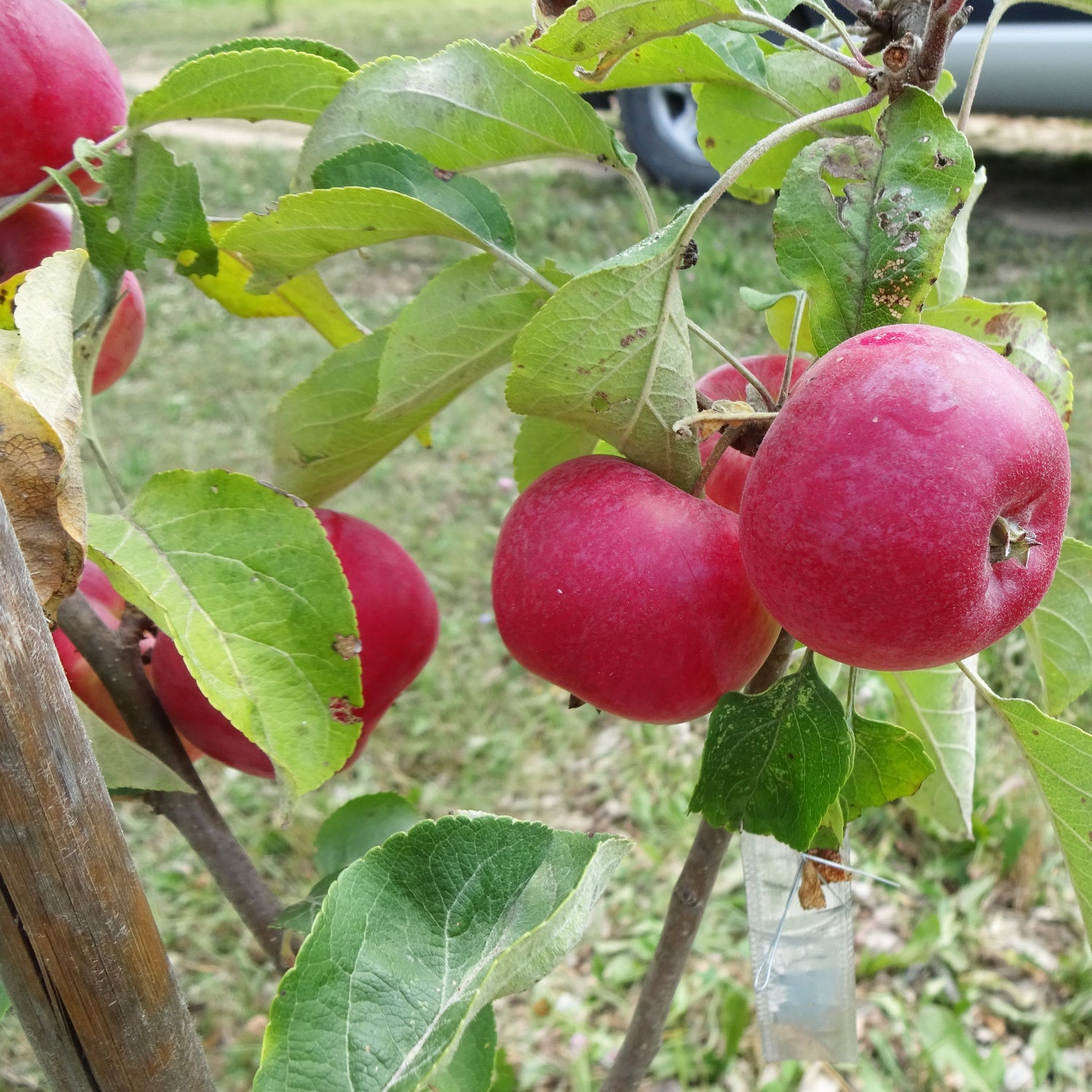
History: Parkland apples were variety created at the Morden Research and Development Centre in Manitoba and released in 1979. Like other varieties developed there, Parkland was designed to withstand the harsh prairie winters and is especially cold hardy. It has become the most commonly grown apple in Alaska after it was brought over in 1985 in an effort to determine which Canadian varieties could survive in the northern state.
Why We Grow It: Parkland is a very satisfying early season apple - sweet and crunchy. It's excellent snacking or applesauce although the fruit is small (about 2" diameter) with creamy flesh and red skin. The tree is quite hardy.

History: Noël des Champs (translated from French as 'Christmas Field') emerged in the Normandy region of France in the 1800s. It has remained a well-regarded apple and is one of thirteen apples prized for cider production in the Pays d'Auge region.
Why We Grow It: This rare cider apple is bittersweet with small, flattish fruits. They are dark red with some striping. As its prestige suggests, this is a good quality cider apple. The tree tends to start bearing fruit at a young age.

History: Lady apples are one of, if not the oldest, apple varieties in existence with a verifiable history. It is said to have originated in the Brittany region of France before 1628 and was grown during the reign of King Louis XIII. This apple goes by several other names as well. It is also known as Api or Pomme d'Api, named after the Forest of Api in France where it is believed this apple may have been discovered. This particular name is similar to Appia, an apple variety popular in Ancient Rome, which some believe is the same apple as Lady. Lady apples are also known as Christmas apples due to their use in adorning Christmas wreaths and trees.
Why We Grow It: It's hard not to be interested in an apple with such a long history as this one. The fruit is small but attractive: red flushed over yellow. The crisp, sweet fruit maintains its good quality all winter in storage.
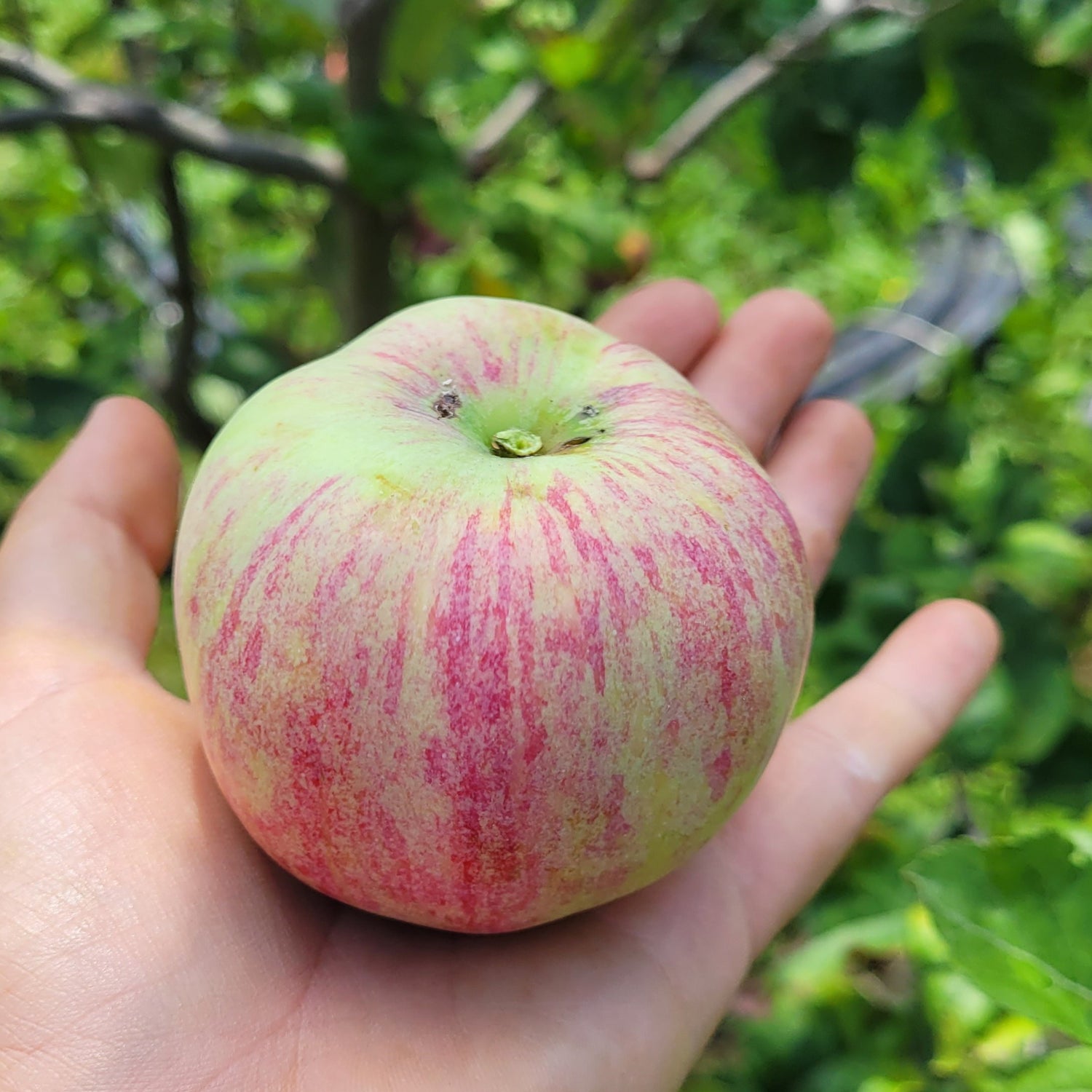
History: This cold-hardy apple was developed in the prairies and is for growing in colder, northern areas.
Why We Grow It: This unique apple produces a yellow fruit with red stripes. It is a rather uncommon variety and is great for sauce. It has begun producing reliably in our test orchard the last few years, and always has a bountiful crop.

History: Wagener apples come from a seed that was planted by George Wheeler in the Finger Lakes area of New York in 1791. In 1796, Abraham Wagener purchased Wheeler's property and planted the seedling on his own property in Penn Yan village where the tree was known for producing attractive, tasty fruit in abundance every year. The variety was named after Wagener and became popular for its excellent storage qualities.
Why We Grow It: Wagener is ideal for the self-sufficient homesteader who values a late keeper, lasting until April in an ordinary cold cellar. When first picked they have a sharp, acidic taste and are great for cooking. In storage, they mellow to an excellent sweet, crisp apple that is perfect for fresh eating.

History: Redfree is one of the apples developed under the collaborative PRI disease-resistant breeding program run by Purdue University, Rutgers University, and the University of Illinois. It was bred in 1966 and officially introduce to the public in 1980.
Why We Grow It: Redfree apples are great for fresh eating with a pleasant, mildly sweet flavour and softer yet crisp flesh. The fruit does not ripen all at once, allowing a longer eating season. As its name would suggest, it has decent resistance to several common apple diseases.
History: Westland apples were developed at the Alberta Special Crops and Horticultural Research Centre in Brooks, Alberta and introduced in 1979.
Why We Grow It: This medium sized pie apple is cold hardy, excellent for the prairies and northern regions. The fruit is large and a pale yellow-ish green with red flush and stripes.

History: Shizuka (translated as "quiet" or "calm") was created at the Aomori Apple Experiment Station in Japan in the 1930s. It is a cross between Golden Delicious and Indo, the same parentage as its sister apple Mutsu.
Why We Grow It: Although it resembles Mutsu with its large yellow-green fruit, sometimes featuring a reddish-orange blush, Shizuka is sweeter and less acidic. This is an excellent fresh-eating apple for farm gate sales and it also keeps well. It is also great in salads due to its slow browning.

Why We Grow It: Another successful introduction from the PRI breeding program, Priscilla boasts resistance to most common apple diseases including fireblight and scab. The fruit is also quite attractive with a deep red blush over yellow skin with a sweet and subacid flavour.

History: Vista Bella was created at Rutgers University in New Jersey in the 1950s and released in 1974. Although its poor keeping ability prevents it from being a commercial success, this early ripening variety is still a nice way to herald in the apple harvest season every year.
Why We Grow It: Vista Bella is the first red apple of the season. The flavour and texture are of better quality than other early apples, making Vista Bella an excellent choice for early farmer’s market sales and roadside stands. The flesh is crisp and juicy, although it softens quickly and, like other early apples, does not keep long.
History: Norhey comes from the Morden Research Station, Agriculture Canada. It was created by Dr. C. R. Ure in the 60's to survive the harsh prairie winters. It was introduced in 1975.
Why We Grow It: It seems Dr. Ure was successful since this is about the hardiest apple we've come across. The fruit has green skin that turns yellow after picking. It's fair for fresh eating, good for cooking and juicing with sweet, sub acid flavours and creamy crisp flesh. The tree has consistent, heavy crops.

History: Fallawater originated in Pennsylvania sometime before 1842, possibly from seeds brought by European colonizers. At one time it was quite popular in the southern United States. This variety has over twenty different names, many of which resemble Fallawater such as Fallenwalder, while others are more fun and unique like Molly Whopper, Green Mountain Pippin, and Prim's Beauty of the West.
Why We Grow It: No matter which name this variety goes by, you can always expect a large, attractive apple with a mildly sweet flavour. Fallawater is an excellent sauce and cooking apple and the fruit stores for a long time.

History: Generally just known as Gravenstein, it is unknown when or where exactly these apples came from but they were imported from France to Denmark in the 1600s by Count Frederik the Younger and planted at the summer residence of the Danish royal family, Gråsten Palace. As a result the variety was named Gråsten (Danish for graystone) which translates to Gravenstein in German. This apple has been popular in Canada since the 1820s, particularly in Nova Scotia, and provided the dried apples and applesauce for American soldiers during WW2. In 2005 it was declared the national apple of Denmark.
Why We Grow It: Yellow Gravenstein's excellence as a fresh eating and cooking apple makes it easy to see why it is grown in so many different countries, even if the tree is slow to bear fruit and is prone to many common fruit tree diseases (although we haven't had much issues growing it here). It has a great sweet/tart flavour and is crunchy and juicy. The fruit is a nice yellow with red striping.

History: White Jersey is another English cider apple whose origins are a little obscure. It was popular in the Somerset area of England during the 1800s where it was first recorded in 1895. It is still grown in modern cider orchards in the UK today.
Why We Grow It: Although it has been deemed an apple with 'average quality juice,' White Jersey is still worth checking out if you are interested in cider making. It does well in the Great Lakes area and it compensates for its average juice quality with good productivity and a tendency to start bearing fruit early.

History: Domaine apples originated in France some time before the 1900s. In the Pays d'Auge region in Normandy, Domaine is one of the 13 cultivars prized for making hard cider (included in that 13 are Fréquin Rouge and Noël des Champs, which we also have available). This apple was brought to the United States in 1949 but remains relatively unknown outside of its country of origin.
Why We Grow It: This bittersharp cider apple is high in tannins and acid but low in sugar. Although not great for single-variety ciders, it can be an excellent addition when used in cider blends.

Why We Grow It: Along with the great sweet flavour and juiciness of the original, Fuji BC #2 also boasts redder skin, making it more appealing for those who prefer red apples.

History: This McIntosh type apple was developed in New Jersey at the Rutgers Agricultural Experiment Station in 1956. It was released commercially in 1971.
Why We Grow It: For McIntosh lovers this is a great apple to grow since it ripens before actual McIntosh apples. It is a bit more tart than McIntosh which makes it great for cooking, baking, and applesauce. It is recommended to use a thickener when baking pies since the flesh cooks down quickly. This tree is also a good cropper.

History: Harrison was first described in 1817 by William Coxe and became a very popular cider variety in New Jersey during the 1800s, making it one of few American varieties renowned for its cider properties. Harrison's popularity declined in the early 1900s and it was believed that this variety was lost to time until it was rediscovered in 1976 growing by an old cider mill in New Jersey. This rediscovery was just in time, as what may have been the last known Harrison trees were cut down only a week later. Following successful propagation, it is once again being grown by cider makers across North America. It is considered one of the best American apples both for fresh eating and cider.
Why We Grow It: Harrison produces a high quality cider and can be made into a single variety cider. Unlike most cider apples, Harrison can also be eaten fresh and has a pleasant if somewhat dry taste. It is also scab resistant and crops reliably each year.

History: Ginger Gold has quite the dramatic origin. In 1969 Hurricane Camille hit Virginia and brought awful floods, devastating the orchards of Clyde and Frances "Ginger" Harvey. As Clyde Harvey went to save the few remaining trees in his Winesap orchard, he discovered a mysterious seedling that produced yellow apples instead of red. Genetic testing showed it was a seedling of Golden Delicious, Albermarle Pippin, and an unknown third variety. Clyde named the variety after his wife and it was introduced commercially in 1982. Since then, it has become a commercially popular early variety! In 2007, the Virginia General Assembly proposed a bill to make Ginger Gold the official state apple, although this bill was sadly tabled.
Why We Grow It: It is easy to see why this such a popular early apple! Ginger Gold produces lovely bright yellow apples that sometimes sport a red blush. These medium-large apples have are firm and juicy with a pleasant sweet flavour that has a nice tart finish. The fruit is slow to brown which makes them even better for fresh-eating along with drying. For fans of feeding wildlife, Ginger Gold apples are known to hang onto the tree well after they are ripe.

History: Bedan des Parts is a French cider apple from Normandy that originated in the 1800s. It is still a popular cider apple in the area today.
Why We Grow It: The continuing popularity of this apple is due to the good quality bittersweet juice it produces that blends well with other varieties. Although a late bloomer, it is quite a heavy cropper.

History: Harry Masters Jersey was discovered in the early 1900s at Yarlington Mill (in England) and is thought to be a seedling of Yarlington Mill (the apple variety). It was named after Mr. Masters, a worker at the mill who is thought to have discovered the apple.
Why We Grow It: Although not the most vigorous of apple trees, the fruit itself boasts a medium-full bittersweet juice of vintage quality with low acid that makes it popular among cider connoisseurs. Harry Masters Jersey also starts producing fruit at a young age.

History: In 1817 Joel Gillet accidentally received Rome Beauty as a seedling in a shipment of nursery trees. His son planted the seedling along the Ohio River in Rome Township. When it began producing lovely red apples, Gillet's cousin started a nursery to propagate and promote it. Originally named Gillet's Seedling, the name was later changed to Rome Beauty in 1832 to honour the township. The original tree collapsed in the 1850s due to bank erosion but the variety still remains popular in the United States today.
Why We Grow It: The fruit is deep red, large, and slightly conical with cream coloured flesh. It has a mild flavour compared to something with more character like a russet, though still an excellent snacking apple. It makes a good cooking apple too since it keeps its shape when cooked. It also stores exceptionally well, lasting all winter long.

Why We Grow It: Although it failed to take off commercially, Silken is an excellent early fresh-eating apple. It is attractive with pale yellow skin sometimes with a faint pinkish blush. The fruit has crisp, juicy flesh that is quite sweet with a little bit of acidity. The tree grows quickly and tends to start bearing fruit at a young age.

History: Rhode Island Greening emerged around 1650 where it was grown from seed by a Mr. Green near Green's End, Rhode Island. Mr. Green owned a tavern and often gave scions from the original tree to his customers, although the tree eventually died from the demand for scionwood. The name was originally the descriptive 'Green's Inn apple from Rhode Island' and later shortened to 'Rhode Island Greening.'* This apple was commonly grown in New York and is still quite common today.
*Fun fact: The Ontario ghost town Unopark got its name in a similar way. It was originally founded by Richard Parker, Mouse's ancestor, and the name is a shortened version of 'You know the Parkers?'
Why We Grow It: This apple's long-lasting popularity is due to its reputation as perhaps the definitive American pie-making apple. The large, dark-green apple is too tart to be eaten fresh but is great in pies and holds its shape well when cooked. It also produces nicely in our test orchard, producing large, blemish-free fruit despite it's generally poor disease resistance.


History: This apple was developed in New York in 1974. It has never achieved major popularity but remains a curiosity due to the deep red colour of its skin which causes the flesh inside to become stained pink.
Why We Grow It: Along with its visual appeal, this apple boasts a sweet, sub-acidic flavour that makes it suitable for both fresh eating and making cider. Although these apples don't store well, the fruit hangs onto the tree for three weeks which helps to keep it available a little longer.
Picture of Burgundy apples on the tree courtesy of Shannon McInnis
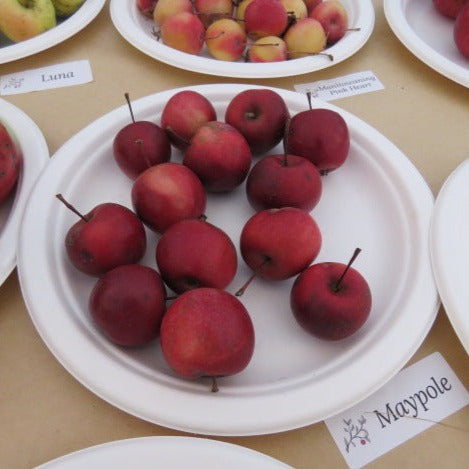
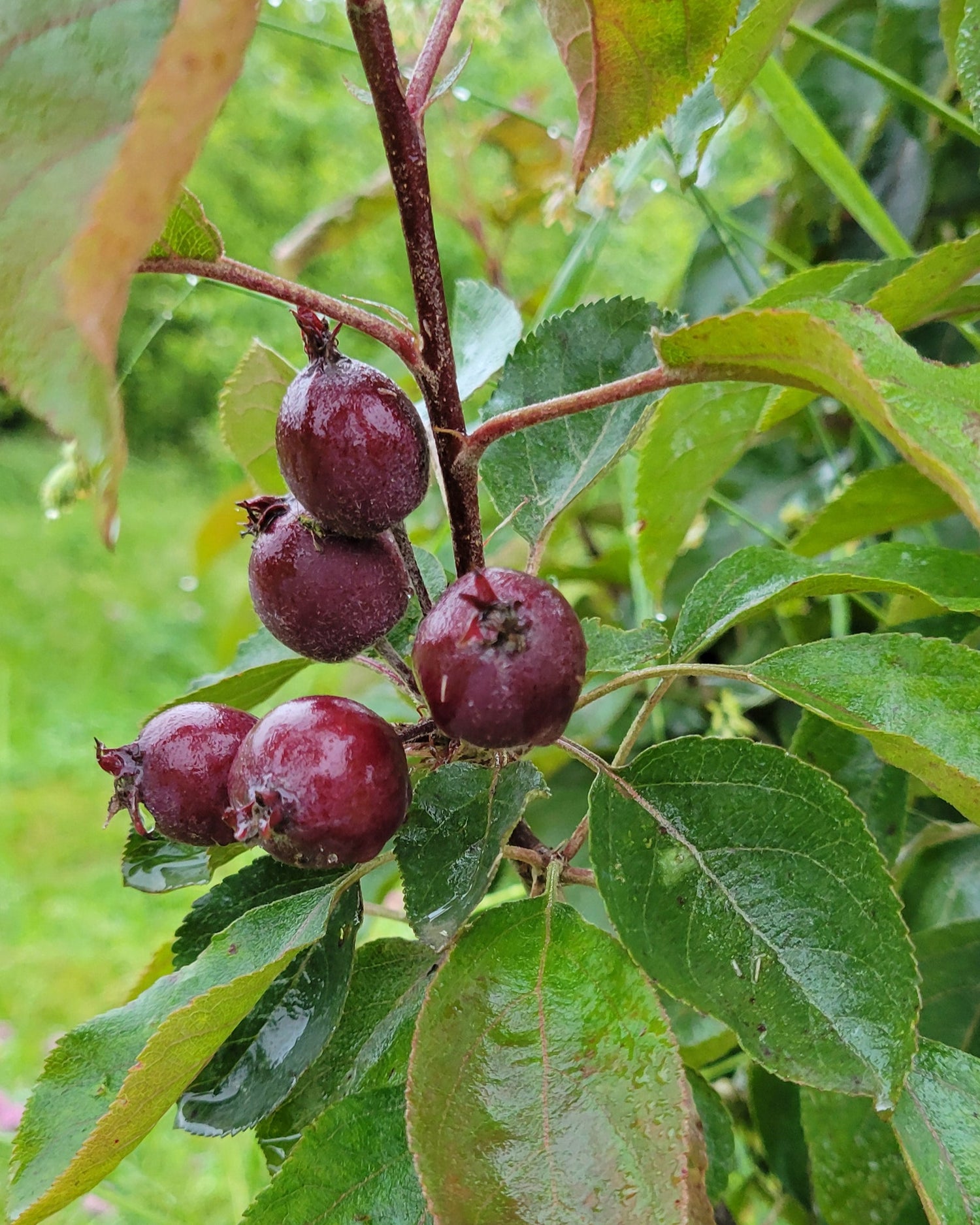
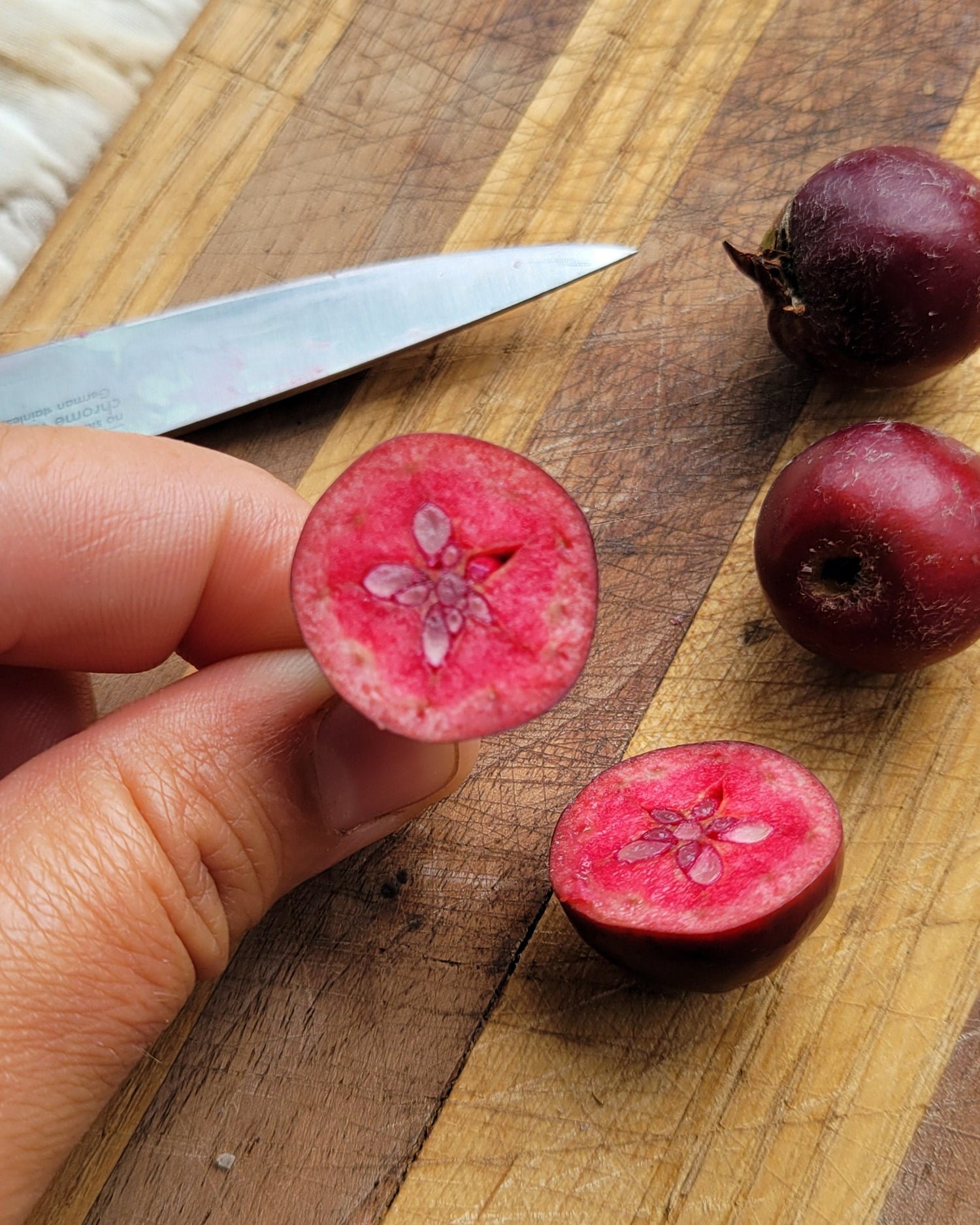
History: Maypole was developed in 1976 by Plant Breeding International at the East Malling Research Station in the UK as a cross between Wijcik Spur McIntosh and Baskatong. Wijcik Spur McIntosh originated as a mutation discovered on a McIntosh tree in 1962 in the Wijcik Orchards in British Columbia, the branch growing oddly straight with little branching. Several varieties were deliberately bred to have this mutation and now Maypole, released in 1986, is one of six columnar varieties developed at the station. This series of trees is known as Ballerina in the UK but due to that name being unavailable in the US, they are known as Colonnade in North America.
Why We Grow It: Not only is Maypole unique as a columnar apple, this crabapple also boasts lovely red flesh, bronze coloured leaves, and pretty pink blossoms in the spring. This makes it overall a lovely ornamental tree to have, whether planted in the yard or in a pot. The fruit is also excellent for jelly, apple butter, and cider, adding a red hue to each. It can also be eaten fresh although it tends to be quite acidic with a touch of sweetness.

History: This vintage quality cider apple is believed to have originated near Martock in England. This apple is so old it's not entirely certain when exactly it was first discovered, with estimates ranging from the 11th to 14th century.
Why We Grow It: This lesser-known apple is bitter with high acid, featuring a fruity flavour with a bitter aftertaste that is great when made into cider on its own or when mixed into a cider blend.
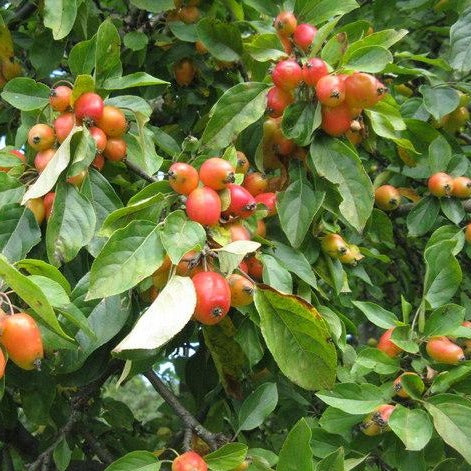
History: John Downie was raised by Edward Holmes, a nursery worker in England, in the 1870s. The variety was named after another nursery worker and friend of Holmes, John Downie. John Downie crabapples remain one of the most popular of the English crabapples.
Why We Grow It: This crabapple sports bright orangey-red fruit, often used to create some of the best jelly around. With its sweet-tart flavour, this crabapple can be pressed into a cheery orange juice that is a great addition to cider blends.

History: Glowing Heart was bred in Toronto by Fred Jansen, one of the founders of the North American Fruit Explorers (NAFEX). This unique apple is still in its early years.
Why We Grow It: This variety has a unique pink and white flesh and is quite acidic. One bite will make you pucker! Although not the best option for fresh eating, this apple creates an aromatic jelly with rich flavour and can be used in ciders as well. It does well in organic orchards.