In-stock Apples_03_2026
Sort by:
151 products
151 products

History: Mindemoya was discovered growing along the shores of Lake Mindemoya on Manitoulin Island along with Mindemoya Maroon. Wayne Kuntze happened upon these trees in 2020 while vacationing with his family. The good size and pinkish striping on the fruit caught his eye, and the sweet flavour sealed the deal! Now in 2023, we are happy to introduce this variety to the world!
Why We Grow It: Always on the search for new varieties, we are happy to grow and offer something that Wayne discovered! Mindemoya is an attractive whitish apple with pinkish-red stripes. It has a pleasantly sweet flavour and plenty of juice, along with a soft texture that may make it good for applesauce along with fresh eating.
This is a brand new variety and we're still learning about it! For any avid apple growers who decide to plant these out, feel free to keep us updated on how it grows, what you use the fruit for, etc, so we can provide as much information as possible!

History: Golden Sentinel was developed at the Pacific Agri-Food Research Centre in Summerland, BC. It was first bred in 1986 as part of a breeding program to create high quality columnar apples. It underwent further testing until 1997, after which it was eventually released.
Why We Grow It: Golden Sentinel is wonderful for a variety of reasons! It produces attractive, large yellow apples with a sweet flavour reminiscent of Golden Delicious. The fruit can be eaten fresh or used for baking. Its columnar growth habit means it stays quite thin, making it a great option for container growing and/or those with limited space. This variety is also quite disease resistant.
History: Whitney crabapples were grown from seed by nurseryman A.R. Whitney around 1865 at Whitney Nursery in Illinois, US. It became popular for its excellent cold hardiness and productivity and in the 1900s the state of Montana recommended it as one of the best crabapple varieties to grow.
Why We Grow It: These large (for a crabapple) yellow and red apples boast a sweet-sharp flavour with some astringency and juicy, crispy flesh. They are a truly multipurpose fruit and can be eaten fresh (if you like some astringency to your apple) or used for cooking, sauce, cider, and jelly. The trees are very cold hardy and boast good disease resistance as well.

Why We Grow It: It is easy to see why growers were so eager to overlook Viking's scab susceptibility, its flavour providing a sweet-tart taste with notes of rose and lychee. It is an excellent all-purpose apple that can be used for cooking, baking, sauce, and cider. Its great flavour and utility is matched by its attractive appearance, the large fruit featuring dark red skin bordering on maroon. However, it does bruise easily and brown quickly and only stores for about a month at most.

History: Major dates back to potentially before the nineteenth century and was commonly grown on farms in Devon and Somerset in England. It remains a traditional English cider variety.
Why We Grow It: Major produces a lovely bittersweet juice that is good both in blends or on its own. It ripens relatively early so it is a nice apple for extending the cider pressing season.

Why We Grow It: It is hard to turn down an apple that sounds as wonderful as Sundance! It is crisp and juicy with a spicy, citric flavour. Along with being great for fresh eating, the fruit also holds its shape well when baked. As an added bonus, this variety is resistant to many common apple diseases and stores quite well so you'll have plenty of high quality apples to easily last you through the winter.

History: Miki* Life was bred in Hirosaki City, Japan in 1981 by Seiichi Kudo and patented in 1996. It is a cross between two popular Japanese varieties: Tsugaru and Senshu.
*without knowing how the name is written in Japanese, it is difficult to say what 'miki' translates to but it could be 'beautiful tree'
Why We Grow It: Like many other Japanese varieties, Miki Life is a lovely red apple that is all sweetness with no acidity. These juicy apples can also be used to help bulk up cider and add alcohol by adding more sugars.

History: Kandil Sinap* originated in the early 1800s around the Black Sea, although it is debated whether it originally came from the Crimean Peninsula in the Ukraine or the Sinop Peninsula in Turkey. It was at one time commonly exported into Russia.
*There are different thoughts on what Kandil Sinap translates to, some say it is 'candle of Sinop,' others 'sweet apple of Sinap,' and it translates directly from Turkish as 'oil lamp'
Why We Grow It: Kandil Sinap's most prominent feature is the odd shape of the fruit, strangely oblong and conical, almost resembling a candle in appearance. The odd green fruit have a sweet, sprightly flavour and are quite aromatic, although they do bruise easily. The tree naturally stays smaller but produces heavy crops and is great for backyard orchards.

History: Holstein was discovered in Schleswig-Holstein, Germany in 1918 and became one of the most popular varieties in the country. It is possibly a seedling of Cox's Orange Pippin.
Why We Grow It: This popular German variety sports attractive yellow skin with an orange/red blush. The flesh is firm, juicy, and aromatic in a way that is reminiscent of Cox's Orange Pippin. In general, this variety is easy to care for and grows vigorously.

Why We Grow It: The saying 'big things come in small packages' holds true for Chinook. Although the fruit is on the smaller side, it boasts a lovely red skin, excellent sweet-tart flavour, a nice aroma, and crisp and juicy flesh. Fans of this variety will be happy to hear that the fruit can be enjoyed well through the winter, it is an excellent keeper and can last 6-7 months in storage. On top of that the tree grows fairly vigorously, starts bearing fruit at a young age, and produces heavy crops (although thinning will be required).
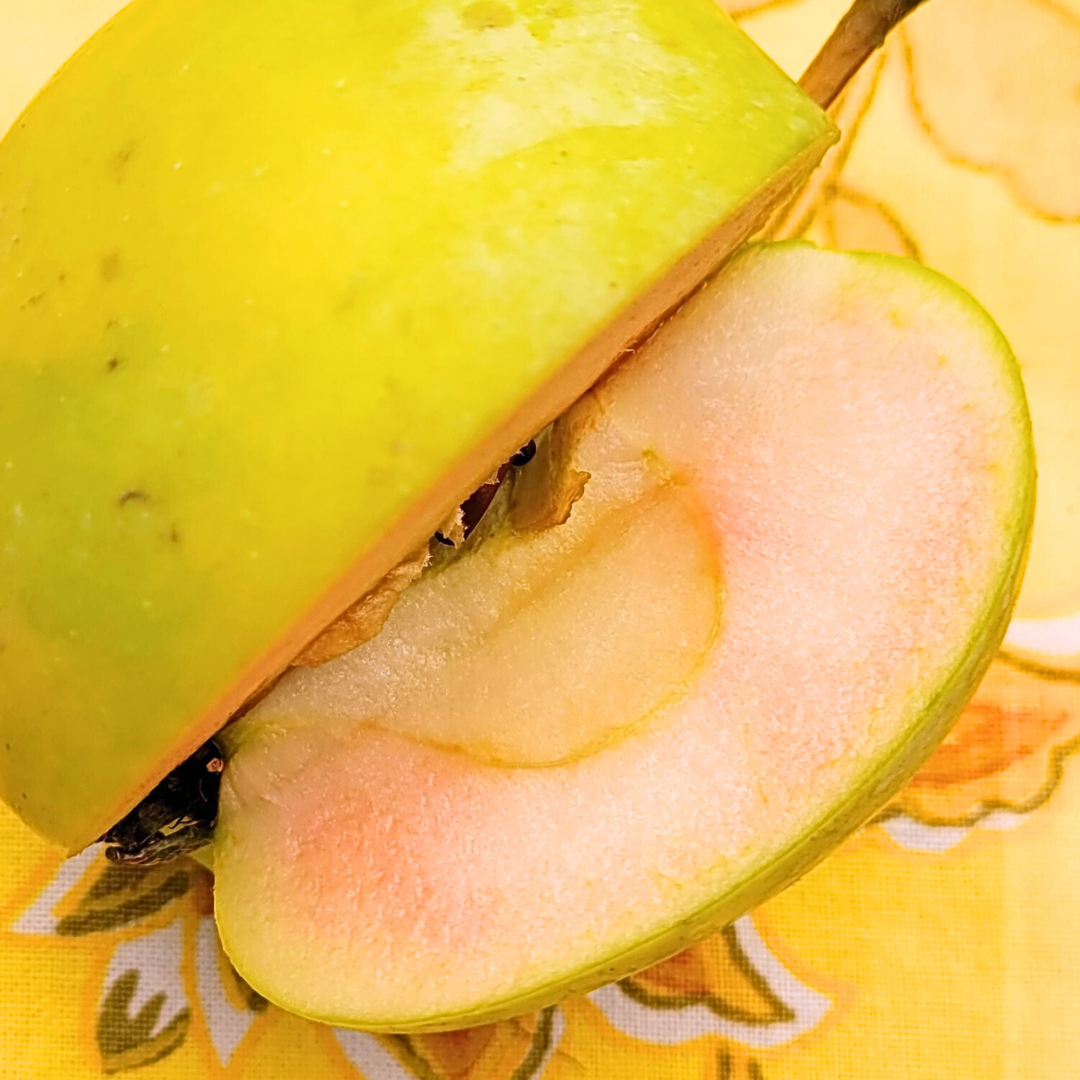
History: Airlie's Red Flesh originated on the farm of Lucky and Audrey Newell in Airlie, Oregon who sold the property in the 1960s. Two decades later in the 1980s, a Louis Kimzey was walking through the old orchard, bit into an apple from the tree, and was amazed at its stunning pink flesh. This was also known as Newell-Kimzey to reference those who found it and Airlie's Red Flesh as a reference to its place of origin and pink flesh. It also goes under a separate brand name.
Why We Grow It: This small, slightly conical apple has yellow skin that belies a bright pink interior that whitens near the core. Not only is it pretty, the fruit has a very sweet flavour with some mild astringency and the flesh is slow to brown. Along with the attractive fruit, the tree boasts bright pink blossoms that gives it an extra ornamental appeal.

History: Not to be confused with Stembridge Cluster, Stembridge Jersey was introduced in Somerset, England, in the 1950s. To this day it remains a popular variety in UK cider orchards.
Why We Grow It: The good-quality bittersweet juice produced by this variety explains why it is still popular in the UK. Although Stembridge Jersey suffers from a tendency to only produce fruit every other year, it does produce good crops in those alternate years and is relatively disease resistant.

History: Paula Red (sometimes written Paulared) was discovered in Michigan in 1960 by Lewis Arends near a ravine where apples were dumped. It was one of several wild apple seedlings that had sprouted up from the discarded seeds. Likely pleased by its attractive red skin and flavour, Arends named it 'Paula Red' in honour of his wife Pauline. It is a cross between Duchess and McIntosh.
Why We Grow It: Paula Red produces medium to large red apples with small yellow/green patches that are juicy and firm with a nice sweet/tart flavour. The flavour has strong vinous and strawberry notes. It is also slower to brown. This early-ripening variety tends to soften relatively quickly which means it does not store very long, but it is great for making applesauce. The tree produces heavy crops although tends to bear every other year as a result.

History: Jalander is a little-known apple with a unique history. Eric Hambly, owner of Siloam Orchards, and his wife visited one of New York's experimental farm stations in the 1980s shortly before it shut down. Hundreds of newly developed disease-resistant apple varieties were slated for destruction, so the couple gathered as much material for propagation as possible and grafted the trees back in Ontario. In the end, five of these trees were chosen for their disease-resistance and taste. One of them was Jalander and it is Hambly's favourite apple among all disease-resistant varieties.
Why We Grow It: For those interested in growing truly rare and unique apples, check out Jalander! On top of its disease-resistance, this apple boasts a sweet-tart taste with character (according to Hambly), and is also crisp and juicy.

History: Brown's Apple was discovered in Devon, UK, in the early 1900s and is considered a traditional English cider apple. It remains quite popular in the area.
Why We Grow It: This traditional variety boasts cold-hardiness and a resistance to scab. It is great for making cider thanks to being simultaneously high in both acid and sugar, an uncommon feature in most apples. Brown's Apple presses to a fragrant, vintage quality juice.

History: Ketchankookem Trail was discovered in 2022 by Wayne Kuntze while he was vacationing on Manitoulin Island with his family. He found it growing wild along Ketchankookem Trail, being drawn to its bright yellow fruit with a pinkish-red blush. Now we are happy to officially introduce this variety in 2023!
Why We Grow It: This variety is worth growing for the name alone! Ketchankookem Trail shares a lot of similarities with Lodi and Yellow Transparent in terms of its early ripening time, yellow skin, and sprightly flavour. Like these other fine early-ripening varieties, it may also be good for sauce along with fresh eating.
This is a brand new variety and we're still learning about it! For any avid apple growers who decide to plant these out, feel free to keep us updated on how it grows, what you use the fruit for, etc, so we can provide as much information as possible!

Why We Grow It: These apples feature red blush over green skin and have a rather flattened appearance. They have an intense pineapple flavour that is a pleasant mix of sweet and sharp, and are also crisp, juicy, and high in Vitamin C. As one can imagine, they are great for fresh eating but can also be used for cooking. The tree is vigorous and produces good crops, but does tend to bear fruit biennially. It is also one of more particular trees, being more sensitive to late frosts and drought conditions.
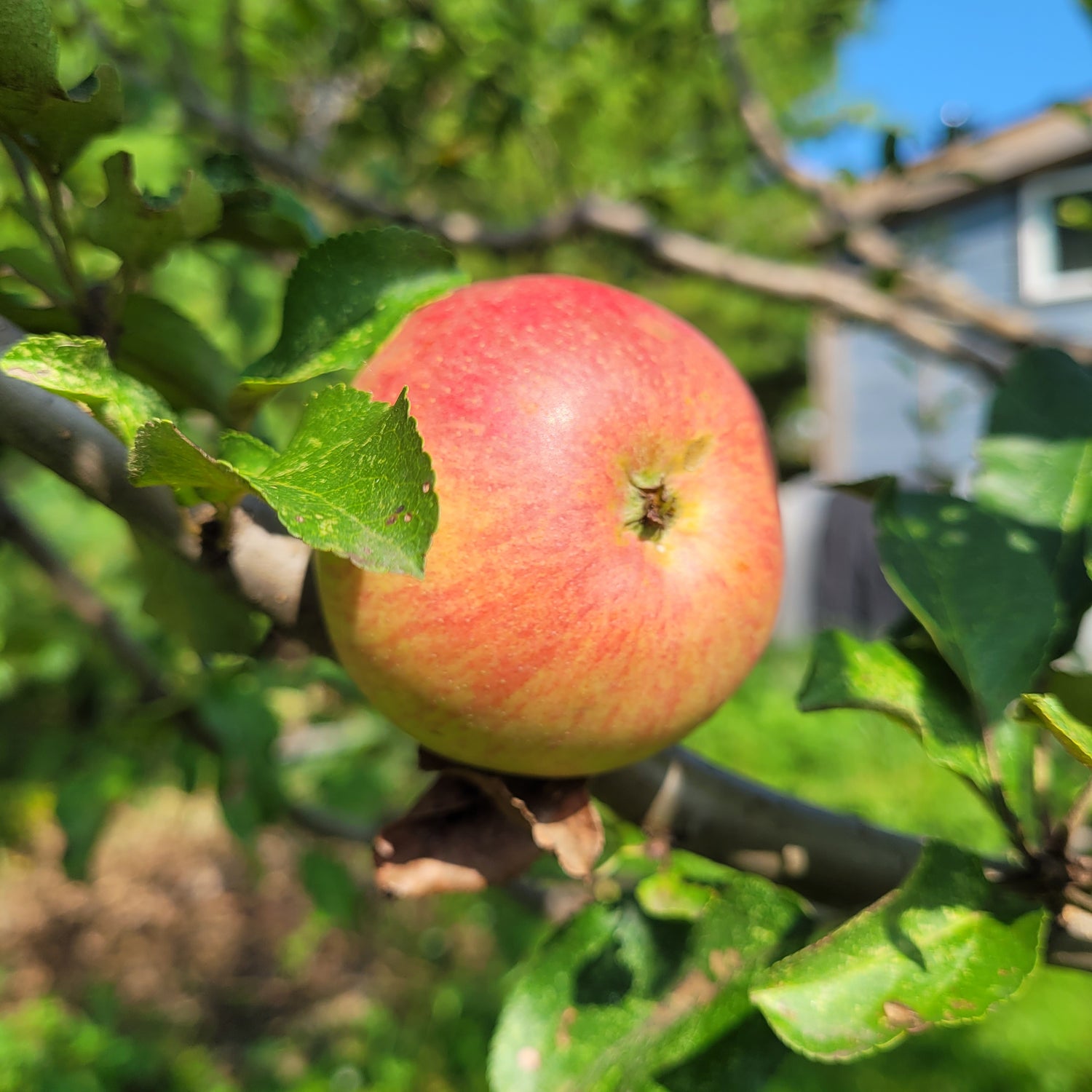
History: Alkmene, aka Early Windsor, was developed by M. Schmidt and H. Murawski at the Kaiser-Wilhelm-Institut für Züchtungsforschung in Müncheberg, Germany in the 1930s.* It was named after Hercules' mother Alcmene. After the chaos of WW2, it took about 30 years for Alkmene to be introduced to the rest of the world. It was released in 1962 and given the name Early Windsor for better marketability. It remains a popular apple in Europe today.
Why We Grow It: Alkmene produces a medium-sized crisp, juicy apple that has yellow skin overlaid with red stripes. The aromatic fruit is known for its rich flavour that is both honeyed and notably sharp. The tree is known to be quite a heavy cropper!
*While the Kaiser Wilhelm Institute was heavily involved with the Nazis during WW2, at the time of Alkmene's development the institute's president was Max Planck, a scientist who staunchly defended his Jewish colleagues. The institute was renamed in his honour following WW2. That is to say, we're not selling a Nazi apple.

Why We Grow It: Pinova produces lovely yellow fruit with pink to red blush and some striping. It is very flavourful with plenty of sweetness and complexity and a strong floral aroma. This crisp, juicy apple is great for fresh eating, produces bountiful crops, and stores exceptionally well. The tree is also resistant to scab and late spring frosts!

Why We Grow It: Discovery is a slightly sweet apple with noticeable acidity, and under optimal conditions it can have a strawberry flavour. Like many early apples, it is great for sauce. The fruit is on the smaller side and has a flatter shape with greenish-yellow skin overlaid with a bright red blush. The red can sometimes stain the cream-coloured flesh inside, providing some visual appeal. The tree boasts some resistance to scab and although it can take a while to start bearing fruit, once it does it bears quite reliably.


History: Karneval (translated from Czech as 'Carnival') was developed at the Institute of Experimental Botany in Prague in the Czech Republic by Dr. Jaroslav Tupý. It is a cross between Vanda and Cripps Pink. It was released in 2011 and like many other modern apples, boasts a sweeter flavour and good disease resistance. However, the main reason this apple was likely selected and given its fun name was for the bright red striped that adorn it.
Why We Grow It: Karneval is medium sized apple that is sweet, juicy and just a little tart and aromatic. However, this apple is best known for its unique appearance: yellow skin with distinct red stripes that would make it feel at home at the circus. Great flavour, striking visual appeal, good storage capabilities, and good disease resistance make this apple an excellent choice for any grower.

History: York Imperial was discovered as a seedling tree growing on the farm of John Kline in Pennsylvania. Nurseryman Jonathan Jessop, of Springwood Farm in York, Pennsylvania, began propagating the variety in 1820 after witnessing schoolboys digging through the leaves around the base of the tree in spring and retrieving apples there were in great condition despite spending all winter on the ground. In an age without refrigeration, Jessop knew this variety had excellent commercial potential. It was initially named Jonathan's Fine Winter for its excellent storage properties but was later renamed York Imperial after horticulturalist Andrew Jackson Downing called it the 'imperial of keepers,' again referencing its storability and the location of Jessop's farm. It quickly became popular and remains one of few heritage apples that are still commonly grown in the US today.
Why We Grow It: York Imperial produces a rather lop-sided fruit with yellow skin and red striping. It is crisp and juicy with a lovely sweet, honeyed flavour that is hard to turn down. The fruit is truly all-purpose, also being great for cooking, baking, jelly, juice, drying, and cider and generally storing quite well. While not the fastest growing tree and with a tendency to start producing fruit a little later than other varieties, York Imperial is an exercise in patience that is well worth the wait.

History: Delbarestivale was developed by Delbard, a nursery in France, in the 1950s. Likely named as a portmanteau of 'Delbard' and 'estivale' (translated from French as 'summer') due to its early ripening time, this variety goes by many other names including Delcorf, Monidel, Dalili, and Ambassy. It was bred in an attempt to create an improved version of Golden Delicious. Although not quite as popular as Golden Delicious, it is still grown commercially in parts of France and England and the Royal Horticultural Society awarded it the Award of Garden Merit in 1998.
Why We Grow It: This French apple is very sweet but balanced nicely with a sharp flavour. The flesh is aromatic and crisp and the skin is a lovely, stripey bi-colour with reddish streaks overlaying green. The apples store quite well for an early-ripening variety, although they do tend to bruise easily.

History: Mother was first officially introduced to the world in an 1844 edition of the "Magazine of Horticulture." We know it came from General Stephen Gardner's farm in Massachusetts in the US but do not know any other details about its origins. It faded from popularity in the US during the 1900s but remained popular in the UK.
Why We Grow It: Mother produces medium-sized apples with yellow skin that turn deep red where exposed to the sun. This crisp, juicy apple is sweet with hints of pear and vanilla making it an excellent choice for fresh eating. It is also a popular option for baking pies! The fruit stores well, the blooms are tolerant of late spring frosts, and the tree tends to start producing at a young age. It is also susceptible to several common apple diseases, but we believe its other qualities outshine that fact.


History: True Root Pippin was discovered on Steph's dad Gary Roth on the family farm in 2022. He happened to come across a large apple tree, a chance seedling, covered in fruit growing along the fenceline and decided to sample them. Pleased by the quality of the apples, we later decided to propagate this lucky find and make these apples available to everyone! It was named True Root Pippin in honour of True Root Nursery, Gary Roth's nursery which is located on the property and is the source of our seedlings. We are happy to introduce True Root Pippin for the first time in 2024.
Why We Grow It: We're always on the lookout for exciting new varieties and this one stood out! True Root Pippin is a pleasant green apple with attractive red striping, albeit it is on the smaller side. It has a good sweet flavour balanced with some tartness. It keeps well and produces nice, clean fruit with minimal care.
Since this is a new variety, there is still a lot for us to learn about it! If you grow this variety and have any observations or find any fun uses for the fruit, we'd love to hear from you!

History: Pine Golden Pippin's exact origins are unknown, but it is quite an old variety that either originated in northern England or in Scotland. It was first formally described by nursery worker Thomas Rivers in A Descriptive Catalogue of Fruit Trees in 1863. In 1875, Robert Hogg claimed that Pine Golden Pippin was one of the best fresh eating apples around in his book The Fruit Manual.
Why We Grow It: Robert Hogg was correct about Pine Golden Pippin! Despite the small size of the fruit, it makes up for it with crisp and juicy fruit with a sweet/sharp flavour that has a hint of pineapple and resin. The fruit is great for fresh eating and can also be used in cider blends. It tends to be slower growing but produces good crops.

Why We Grow It: Melrose produces a flattish apple that has greenish skin overlaid with a bright red flush. It is firm, juicy, and sweet with a more acidic flavour that improves after a little while in storage. It is great for both fresh eating and cooking and can be stored for several months. The tree itself starts to bear at a young age and produces heavy crops, although it has a tendency to bear fruit every other year.

History: Pewaukee originated around the mid-1800s when George Peffer, owner of Pewaukee Fruit Farm & Nursery, crossed Duchess of Oldenburg with Northern Spy on his farm in Pewaukee, Wisconsin. The resulting apple, a cross of two varieties well known for their use in cooking, is great for a variety of culinary uses! It was formally recorded as a variety in 1870 and can still be found in old orchards in parts of the US today.
Why We Grow It: Pewaukee produces a yellow apple with red striping that has sweet, crisp flesh with a hint of vanilla. It is great for fresh eating and excels for sauce, cooking, and baking. The tree is known for being hardy and producing fruit at a young age.


History: Fresco, also known by the brand name Wellant®, was developed through a fruit breeding collaboration between Inova Fruit and the Applied Plant Research at the Wageningen University and Research Center in the Netherlands. The goal was to create an apple variety that better aligned with changing consumer tastes. It was bred in the late 1900s and named Fresco during the years it underwent various tests before being released in 2004 under the brand name Wellant®. It is primarily grown and sold in Europe.
Why We Grow It: Fresco produces a large, deep red fruit that is crunchy with a strong flavour high in both sweetness and tartness. It is excellent for fresh eating and can be used in baking and cooking as well. An excellent multi-purpose apple!


History: Woolbrook Pippin originated in 1903 at Woolbrook Nursery in the UK. It was discovered by J.H. Stevens and Son. It is a Cox's Orange Pippin seedling and received an Award of Merit from the Royal Horticultural Society in 1929.
Why We Grow It: Woolbrook Pippin produces a greenish apple overlaid with bright red stripes that is excellent for fresh eating. The fruit is firm, crisp, and juicy with a sweet, aromatic flavour balanced by a bit of tartness. This is a great choice for fans of Cox's Orange Pippin!