In-Stock Apples
Malus domestica
A handy collection of all the apple varieties we currently have in stock!
108 products
Sort by:
108 products
108 products

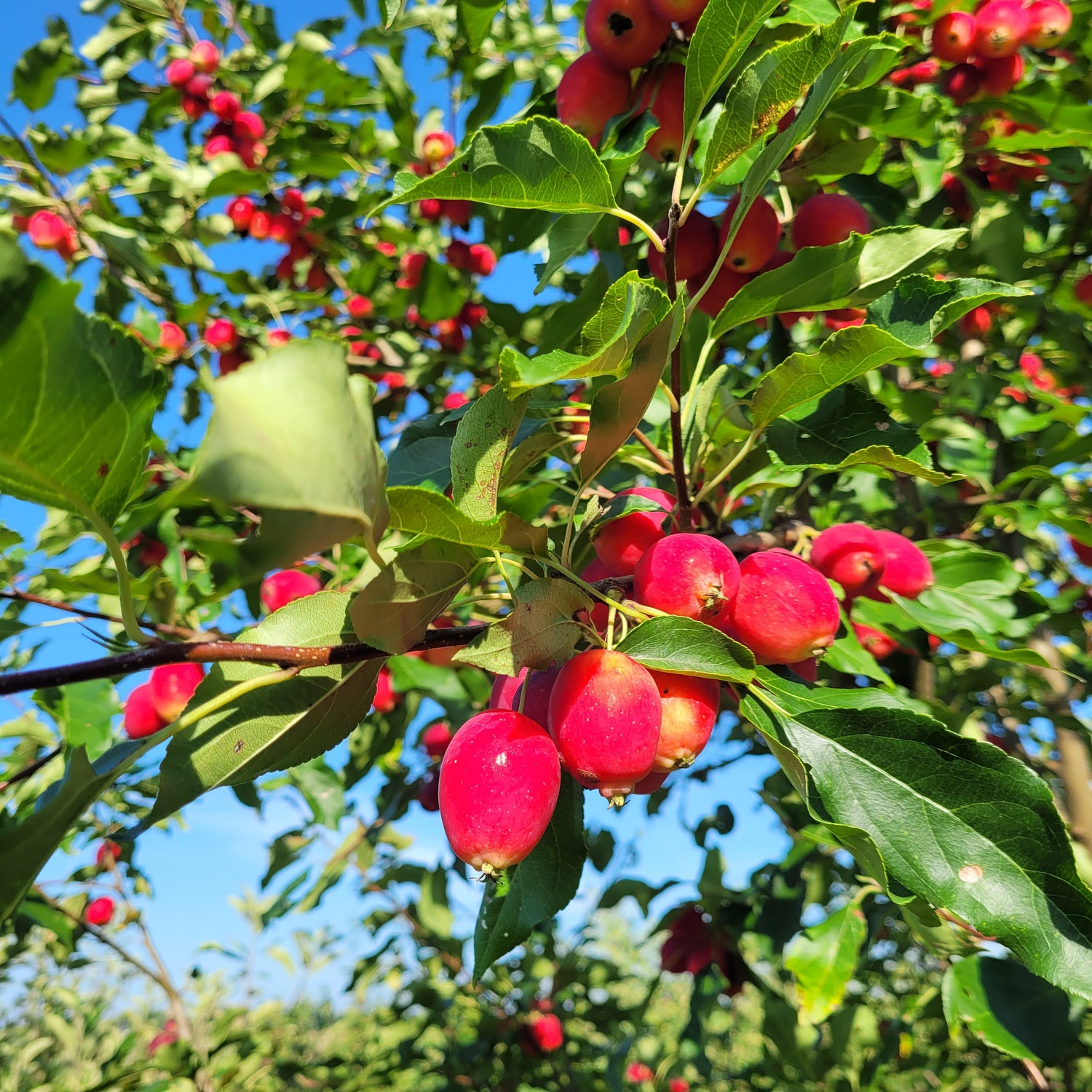
History: Dolgo is a variety of Siberian crabapple (Malus baccata) that originated in Russia. Due to the slightly elongated shape of the fruit, this variety was named 'dolgo' which means 'long' in Russian. They were brought to the United States by N. E. Hansen around 1897.
Why We Grow It: Dolgo is a classic crabapple with a vibrant flavour, very tangy and delicious right off the tree in the heat of summer- as refreshing as lemonade! The bright red fruits are about the size of small plums. These apples are excellent for making jelly or as a unique addition to a cider blend. Along with being exceptionally cold hardy, the trees themselves are quite pretty and are often planted ornamentally.

History: Red Gravenstein is a sport/mutation of the original Gravenstein/Yellow Gravenstein that is a striking bright red. Some say it is also sweeter than the original.
Why We Grow It: With attractive red skin, this is a lovely sport of the original Gravenstein. It is a good quality and sweet early apple that is excellent for home orchards.
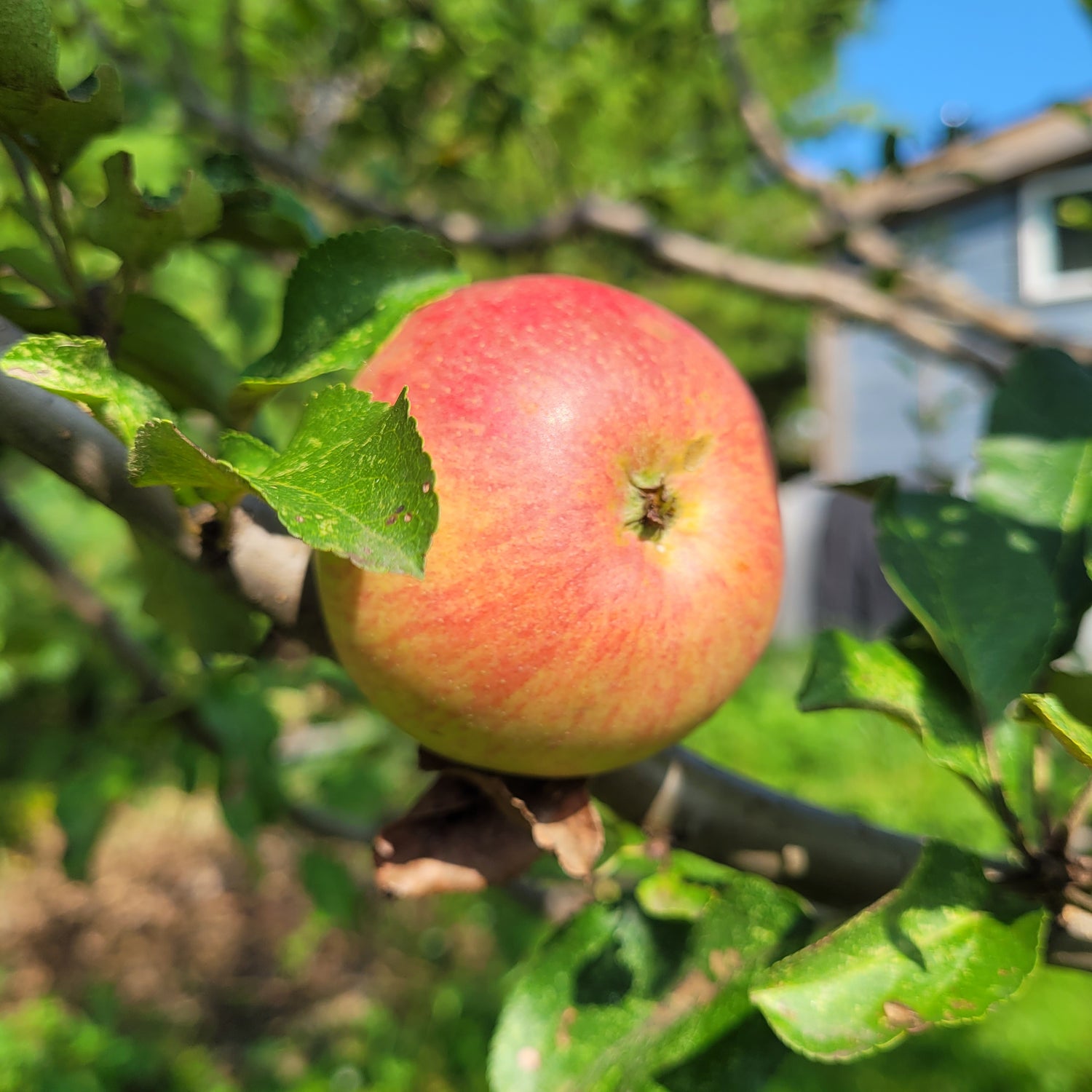
History: Alkmene, aka Early Windsor, was developed by M. Schmidt and H. Murawski at the Kaiser-Wilhelm-Institut für Züchtungsforschung in Müncheberg, Germany in the 1930s.* It was named after Hercules' mother Alcmene. After the chaos of WW2, it took about 30 years for Alkmene to be introduced to the rest of the world. It was released in 1962 and given the name Early Windsor for better marketability. It remains a popular apple in Europe today.
Why We Grow It: Alkmene produces a medium-sized crisp, juicy apple that has yellow skin overlaid with red stripes. The aromatic fruit is known for its rich flavour that is both honeyed and notably sharp. The tree is known to be quite a heavy cropper!
*While the Kaiser Wilhelm Institute was heavily involved with the Nazis during WW2, at the time of Alkmene's development the institute's president was Max Planck, a scientist who staunchly defended his Jewish colleagues. The institute was renamed in his honour following WW2. That is to say, we're not selling a Nazi apple.


History: Priscilla is the second apple variety developed through the collaborative PRI disease-resistant breeding program run by Purdue University, Rutgers University, and the University of Illinois. It was planted in 1962 and has a complex heritage that includes Starking Delicious, McIntosh, Golden Delicious, and Rome Beauty. It was introduced in 1972 and named 'Priscilla' after Priscilla Hovde, the wife of the seventh president of Purdue University as it happened to fit the 'pri' naming scheme for the varieties developed through the program.
Why We Grow It: Another successful introduction from the PRI breeding program, Priscilla boasts resistance to most common apple diseases including fireblight and scab. The fruit is also quite attractive with a deep red blush over yellow skin with a sweet and subacid flavour.

History: Luna (translated from Latin as "moon") comes from a cross between Golden Delicious and Topaz. It was bred in 1999 by Dr. Jaroslav Tupý at the Institute of Experimental Botany in Prague in the Czech Republic. The variety was likely selected for its excellent flavour, storage capabilities, and disease resistance. It was released in 2006.
Why We Grow It: Luna produces a medium to large yellow apple that bears a strong resemblance to its parent, Golden Delicious. Like Golden Delicious, it is a sweet fresh eating apple that is firm and crisp. It can last in storage for about six months and the flavour is said to be at its best after about three weeks in storage. Luna also boasts good disease resistance and tendency to start producing fruit at a young age.

History: Rhode Island Greening emerged around 1650 where it was grown from seed by a Mr. Green near Green's End, Rhode Island. Mr. Green owned a tavern and often gave scions from the original tree to his customers, although the tree eventually died from the demand for scionwood. The name was originally the descriptive 'Green's Inn apple from Rhode Island' and later shortened to 'Rhode Island Greening.'* This apple was commonly grown in New York and is still quite common today.
*Fun fact: The Ontario ghost town Unopark got its name in a similar way. It was originally founded by Richard Parker, Mouse's ancestor, and the name is a shortened version of 'You know the Parkers?'
Why We Grow It: This apple's long-lasting popularity is due to its reputation as perhaps the definitive American pie-making apple. The large, dark-green apple is too tart to be eaten fresh but is great in pies and holds its shape well when cooked. It also produces nicely in our test orchard, producing large, blemish-free fruit despite it's generally poor disease resistance.

History: Not to be confused with Stembridge Cluster, Stembridge Jersey was introduced in Somerset, England, in the 1950s. To this day it remains a popular variety in UK cider orchards.
Why We Grow It: The good-quality bittersweet juice produced by this variety explains why it is still popular in the UK. Although Stembridge Jersey suffers from a tendency to only produce fruit every other year, it does produce good crops in those alternate years and is relatively disease resistant.
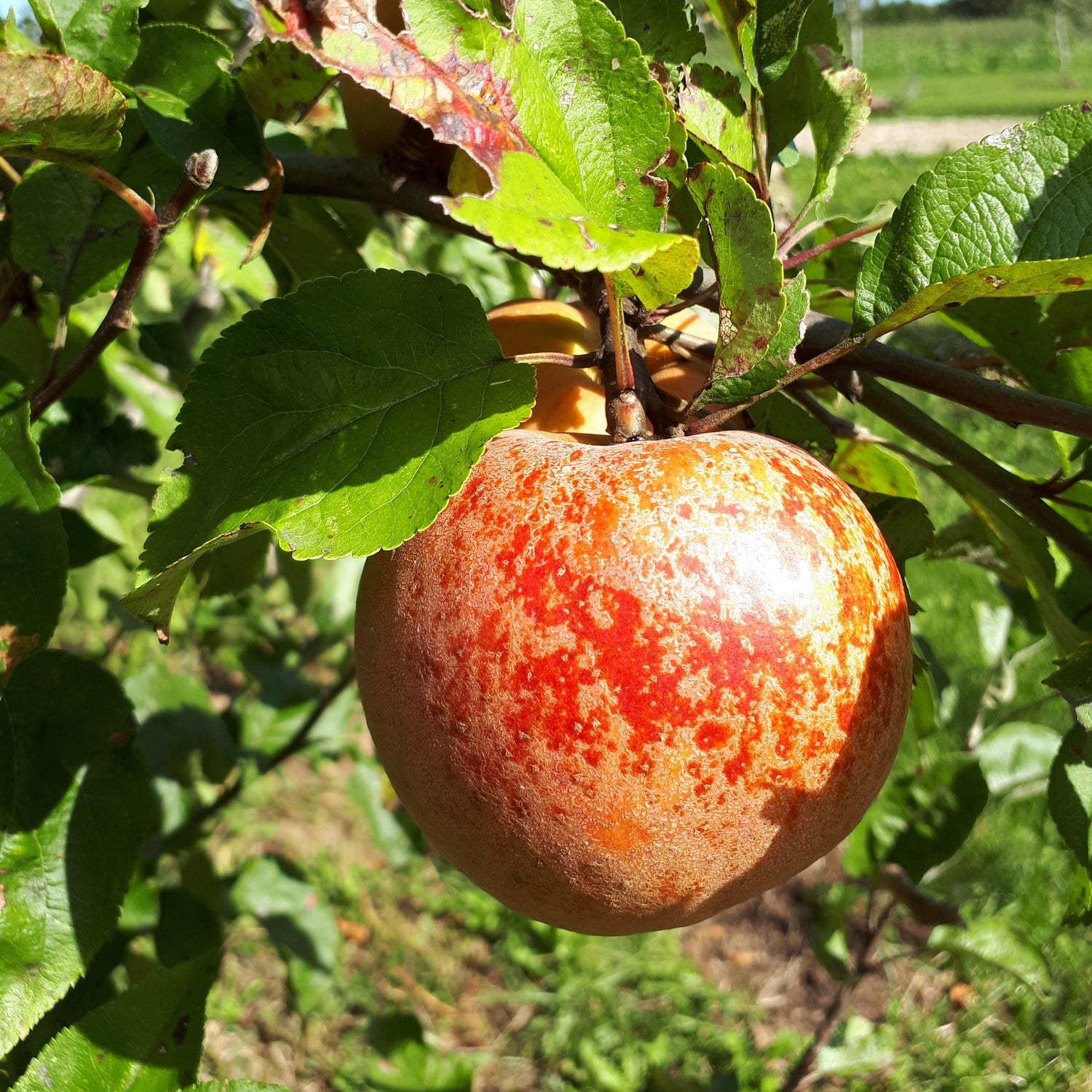
History: Roxbury Russet is the oldest American apple still under cultivation. It was discovered around 1650 in Roxbury, near Boston. These apples were well-known for their long keeping ability and qualities for cider making. They were grown by Thomas Jefferson at Monticello and are even referenced in one of Nathanial Hawthorne's novels. Due to the russet skin, these apples have never achieved true commercial success but they can still be commonly found in American farmer's markets.
Why We Grow It: Aside from its historic roots, Roxbury Russet is an excellent all-around apple that can be eaten fresh, used in cooking, and made into a great cider. It has a nice flavour that is sweet and sharp. This variety is also a good choice for organic orchards.


History: Little is known about Muscadet de Dieppe aside from the fact it originated near the port of Dieppe in Normandy, France. It was commonly grown in the area since 1750 at least.
Why We Grow It: Considering this French cider variety was popular in an area known for its cider, this makes for a classic cider apple. The juice is bittersweet and aromatic which is excellent in both single-variety ciders and cider blends.


History: Once one of the most popular commercial apples in the United States, Ben Davis apple trees were planted across the continent following its discovery around 1800. Due to its firm fruit and excellent keeping qualities, this apple was extremely easy to transport over longer distances which led to its popularity. Once storage and transportation improved, this apple was slowly replaced with better tasting varieties and it is now a relatively rare find. It's also a parent to Cortland.
Why We Grow It: The mellow, sub-acidic, mildly aromatic red fruit is not quite as flavourful as some apples but it stores exceptionally well, lasting into spring. Flavour improves in storage, like many heritage apples. The trees are reliable and heavy croppers, earning them the nickname of 'mortgage-lifters' when they were grown commercially.

History: Sekai Ichi (translated literally from Japanese as 'world number one,' more accurately meaning 'best in the world') was bred at the Prefectural Experiment Station in Aomori, Japan in 1930 and released in 1974. It is a cross between Red Delicious and Golden Delicious. This variety is quite highly regarded in Japan where a single apple can sell for as much as $25 each. Each apple is hand pollinated, washed in honey, and hand-stamped while being inspected to ensure its quality.
Why We Grow It: Although we don't get quite that fancy here, Sekai Ichi is nonetheless a great apple if you enjoy sweet, crunchy, apples with no acidity, as is common with Japanese varieties. It is red over greenish skin and very large with an average circumference of 30-45cm and average weight of 2lb. The tree itself is very vigorous although slow to start bearing fruit with a tendency towards biennial bearing.

History: AKA Co-op 30, Enterprise is one of the many varieties that was developed through the collaborative PRI disease-resistant breeding program run by Purdue University, Rutgers University, and the University of Illinois. It was introduced in 1993 and has proven to be a very reliable variety. Although its name does not start with 'PRI' like many of the other varieties that came from this program, they still snuck the initials into Enterprise's name.
Why We Grow It: Enterprise produces crisp fruit that it is known for its strong, rich, tart flavour that can be described as spiced. It is a very disease-resistant variety that grows quickly, produces reliable crops, and stores for a long time. They are good for fresh eating although the skin is on the thicker side, and they can be used for cooking, baking, and sauce.
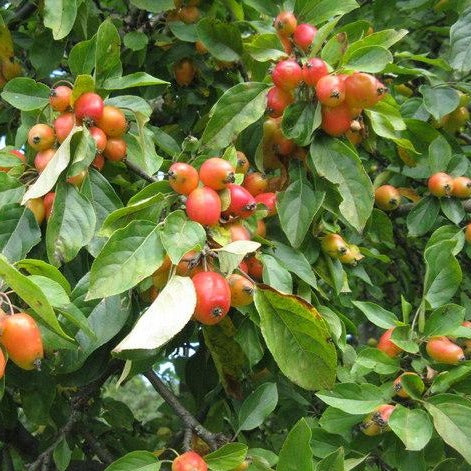
History: John Downie was raised by Edward Holmes, a nursery worker in England, in the 1870s. The variety was named after another nursery worker and friend of Holmes, John Downie. John Downie crabapples remain one of the most popular of the English crabapples.
Why We Grow It: This crabapple sports bright orangey-red fruit, often used to create some of the best jelly around. With its sweet-tart flavour, this crabapple can be pressed into a cheery orange juice that is a great addition to cider blends.


History: This McIntosh type apple was developed in New Jersey at the Rutgers Agricultural Experiment Station in 1956. It was released commercially in 1971.
Why We Grow It: For McIntosh lovers this is a great apple to grow since it ripens before actual McIntosh apples. It is a bit more tart than McIntosh which makes it great for cooking, baking, and applesauce. It is recommended to use a thickener when baking pies since the flesh cooks down quickly. This tree is also a good cropper.

History: Mother was first officially introduced to the world in an 1844 edition of the "Magazine of Horticulture." We know it came from General Stephen Gardner's farm in Massachusetts in the US but do not know any other details about its origins. It faded from popularity in the US during the 1900s but remained popular in the UK.
Why We Grow It: Mother produces medium-sized apples with yellow skin that turn deep red where exposed to the sun. This crisp, juicy apple is sweet with hints of pear and vanilla making it an excellent choice for fresh eating. It is also a popular option for baking pies! The fruit stores well, the blooms are tolerant of late spring frosts, and the tree tends to start producing at a young age. It is also susceptible to several common apple diseases, but we believe its other qualities outshine that fact.

History: Harrison was first described in 1817 by William Coxe and became a very popular cider variety in New Jersey during the 1800s, making it one of few American varieties renowned for its cider properties. Harrison's popularity declined in the early 1900s and it was believed that this variety was lost to time until it was rediscovered in 1976 growing by an old cider mill in New Jersey. This rediscovery was just in time, as what may have been the last known Harrison trees were cut down only a week later. Following successful propagation, it is once again being grown by cider makers across North America. It is considered one of the best American apples both for fresh eating and cider.
Why We Grow It: Harrison produces a high quality cider and can be made into a single variety cider. Unlike most cider apples, Harrison can also be eaten fresh and has a pleasant if somewhat dry taste. It is also scab resistant and crops reliably each year.

History: Little is known about Kermerrien aside from the fact it originated in the Quimplerlé region in France. It was exhibited by an orchardist at an event in 1896 and was described in a book on cider apples published in the same year, but it is unknown how old the variety is. It is commonly used to make traditional Breton cider.
Why We Grow It: This bittersweet cider apple produces a good single-variety cider with a nice golden juice. The tree is vigorous and starts bearing at a young age.
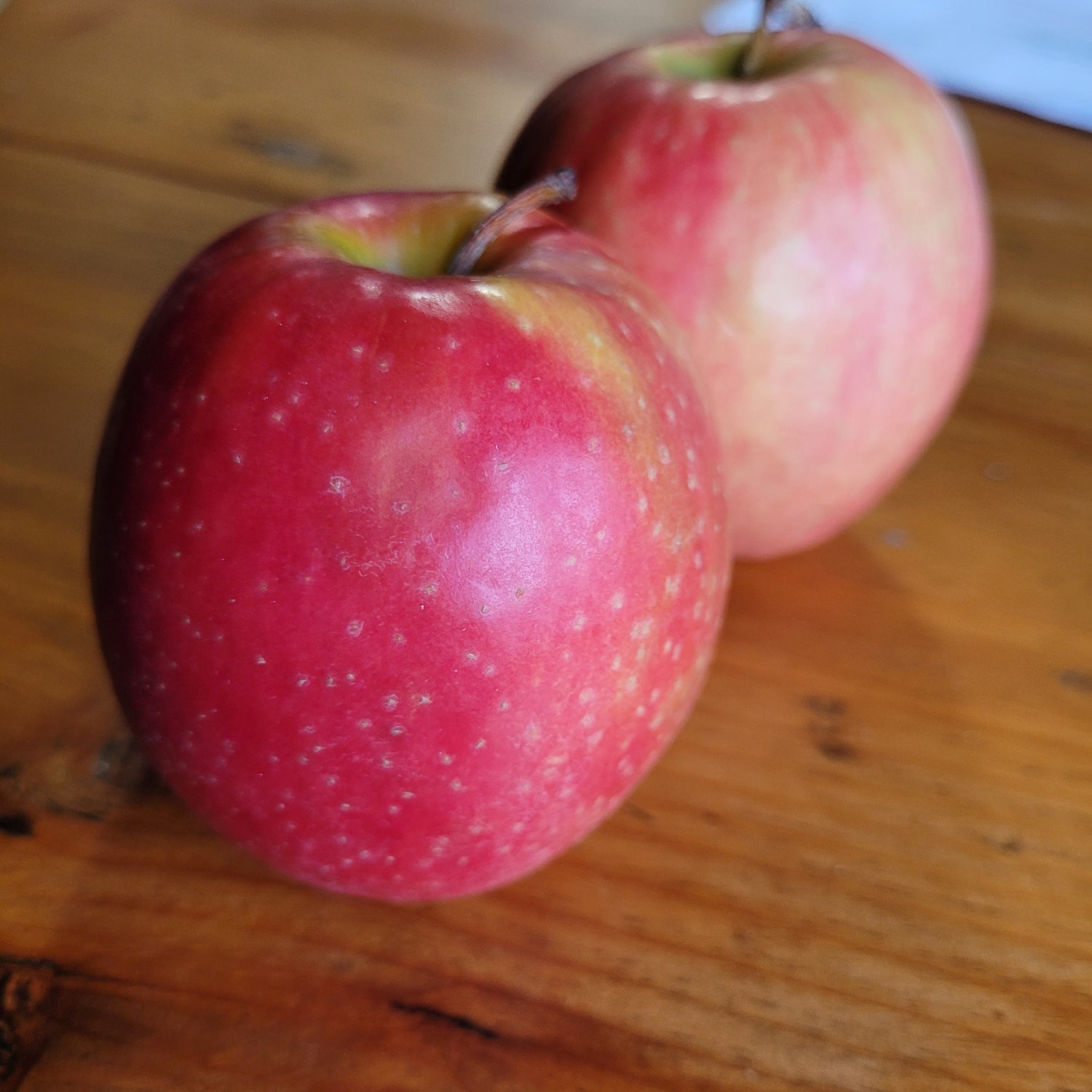
History: Cripps Pink was developed by John Cripps at the Western Australia Department of Agriculture in 1973 as a cross between Lady Williams (an Australian variety) and Golden Delicious. The successful result was introduced to the market in 1985. In just ten years, Cripps Pink became an extremely popular variety and over a million trees were planted in Australia alone. This variety remains popular in many countries around the world. This apple is also known as Pink Lady which is its brand name when the fruit meets very strict criteria for quality.
Why We Grow It: Cripps Pink has a refreshing honeyed sweet-tart flavour that makes it great for fresh eating, baking, and cider. The lovely fruit, yellow with a pinkish-red blush, is slow to brown and also stores exceptionally well.