apple qty discount




181 products
Sort by:
181 products
181 products

History: Greensleeves was bred as a cross between James Grieve and Golden Delicious by Dr. Frank Alston at the East Malling Research Station in the UK in 1966. In 1981 it received the Royal Horticulture Society Award of Merit and was released the year after.
Why We Grow It: These round, golden apples have a nice sweet/tart flavour that mellows out with maturity. They are great for making juice or cider as well as fresh eating. The tree has low vigour so it naturally stays more compact, a useful feature if you don't have a lot of space.

History: Not to be confused with Stembridge Cluster, Stembridge Jersey was introduced in Somerset, England, in the 1950s. To this day it remains a popular variety in UK cider orchards.
Why We Grow It: The good-quality bittersweet juice produced by this variety explains why it is still popular in the UK. Although Stembridge Jersey suffers from a tendency to only produce fruit every other year, it does produce good crops in those alternate years and is relatively disease resistant.

History: York Imperial was discovered as a seedling tree growing on the farm of John Kline in Pennsylvania. Nurseryman Jonathan Jessop, of Springwood Farm in York, Pennsylvania, began propagating the variety in 1820 after witnessing schoolboys digging through the leaves around the base of the tree in spring and retrieving apples there were in great condition despite spending all winter on the ground. In an age without refrigeration, Jessop knew this variety had excellent commercial potential. It was initially named Jonathan's Fine Winter for its excellent storage properties but was later renamed York Imperial after horticulturalist Andrew Jackson Downing called it the 'imperial of keepers,' again referencing its storability and the location of Jessop's farm. It quickly became popular and remains one of few heritage apples that are still commonly grown in the US today.
Why We Grow It: York Imperial produces a rather lop-sided fruit with yellow skin and red striping. It is crisp and juicy with a lovely sweet, honeyed flavour that is hard to turn down. The fruit is truly all-purpose, also being great for cooking, baking, jelly, juice, drying, and cider and generally storing quite well. While not the fastest growing tree and with a tendency to start producing fruit a little later than other varieties, York Imperial is an exercise in patience that is well worth the wait.


History: While on vacation on Manitoulin Island in 2022, Wayne Kuntze found Manitowaning Pink Heart growing wild in the corner of the Gulyas family's yard and (with permission) brought the apples and some grafting material back to Silver Creek Nursery. The distinct pink colour and the heart shape of the fruit caught his eye, along with the pink flesh inside. Fittingly, he named it Manitowaning Pink Heart after the village where the property was located and the unique appearance of the apple. A truly unique variety, we are happy to officially introduce it in 2023!
Why We Grow It: We love unusual apple varieties and Manitowaning Pink Heart really stands out! With its attractive pink blush over yellow skin, pink flesh, and heart-shaped fruit, this is a one of a kind apple! Despite its sweet appearance, this crabapple is quite tart and tannic. Like other crabapples, this one is best suited for jelly and cider. Its pink flesh may help add a distinctive colouration.
This is a brand new variety and we're still learning about it! For any avid apple growers who decide to plant these out, feel free to keep us updated on how it grows, what you use the fruit for, etc, so we can provide as much information as possible!
Bloom photo courtesy of Christine Gulyas

History: Nonpareil originated in France although no one is sure quite how old it is or what its exact origins are. We do know that it was brought over to England sometime in the 1500s where it gained more popularity due to its pear-drop flavour. It can still be found at markets, farmgate sales, and in gardens in England to this day and is believed to be the ancestor of the popular European variety Ashmead's Kernel.
Why We Grow It: Nonpareil is not much to look at with its dull yellow-green russet skin but it packs a flavourful punch: sweet-sharp with notes of pear-drops. The fruits hangs onto the tree well and stores for several months. It is mainly used for fresh eating but can be added to cider blends as well. The tree is naturally more compact and has moderate vigour.
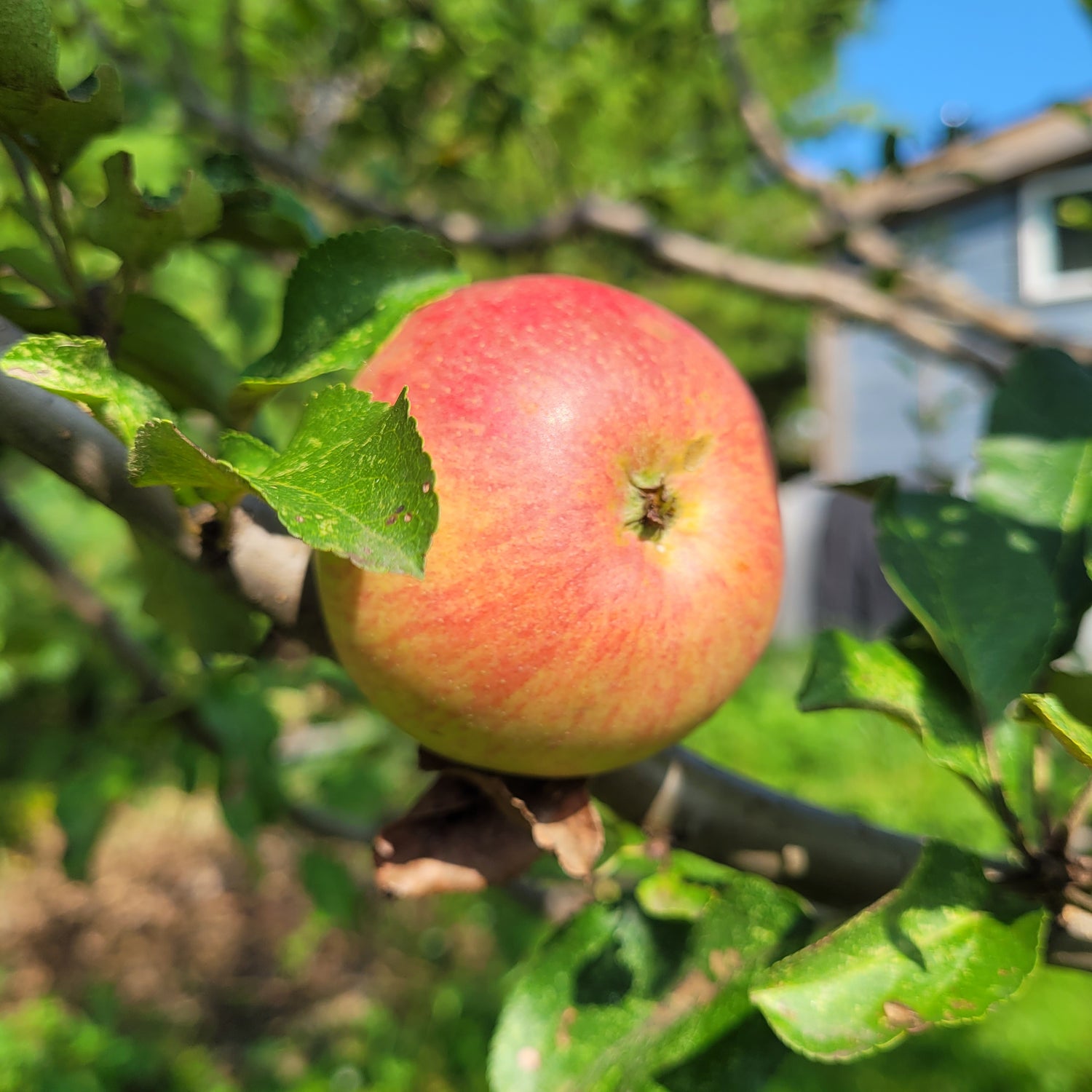
History: Alkmene, aka Early Windsor, was developed by M. Schmidt and H. Murawski at the Kaiser-Wilhelm-Institut für Züchtungsforschung in Müncheberg, Germany in the 1930s.* It was named after Hercules' mother Alcmene. After the chaos of WW2, it took about 30 years for Alkmene to be introduced to the rest of the world. It was released in 1962 and given the name Early Windsor for better marketability. It remains a popular apple in Europe today.
Why We Grow It: Alkmene produces a medium-sized crisp, juicy apple that has yellow skin overlaid with red stripes. The aromatic fruit is known for its rich flavour that is both honeyed and notably sharp. The tree is known to be quite a heavy cropper!
*While the Kaiser Wilhelm Institute was heavily involved with the Nazis during WW2, at the time of Alkmene's development the institute's president was Max Planck, a scientist who staunchly defended his Jewish colleagues. The institute was renamed in his honour following WW2. That is to say, we're not selling a Nazi apple.

Why We Grow It: Pinova produces lovely yellow fruit with pink to red blush and some striping. It is very flavourful with plenty of sweetness and complexity and a strong floral aroma. This crisp, juicy apple is great for fresh eating, produces bountiful crops, and stores exceptionally well. The tree is also resistant to scab and late spring frosts!
History: Arkansas Black originated, as its name implies, in Arkansas sometime in the mid to late 1800s although there are conflicting opinions on who exactly discovered it. Some say John Crawford developed it in the 1840s, others believe DeKalb Holt developed it at his brother's nursery in the 1870s, and another account claims John Braithwaite found it growing in his orchard. Regardless, this unique looking apple eventually became the most popular apple in the state until a bad codling moth infestation followed by the Great Depression devastated commercial orchards. Despite this heavy blow, it is still a popular apple in backyards and small-scale orchards.
Why We Grow It: Arkansas Black produces a unique fruit that is a dark purplish-red that at times almost looks black. Fresh off the tree the fruit is hard and fairly acidic, but it softens and sweetens in storage and develops a more pronounced spiced flavour. It is good for pies, sauce, and cider and the fruit stores quite well! The tree itself is fairly disease resistant as well.

Why We Grow It: These apples feature red blush over green skin and have a rather flattened appearance. They have an intense pineapple flavour that is a pleasant mix of sweet and sharp, and are also crisp, juicy, and high in Vitamin C. As one can imagine, they are great for fresh eating but can also be used for cooking. The tree is vigorous and produces good crops, but does tend to bear fruit biennially. It is also one of more particular trees, being more sensitive to late frosts and drought conditions.


History: Waxing Moon was discovered by Steph's cousin Liam Younger who has spent many summers working here at the nursery! He found it growing as a chance seedling on his family farm in 2023, drawn in by the apple's pale white skin. Naming the variety Waxing Moon for its moon-like appearance, he grafted a small number of the trees here and we are happy to introduce the variety in 2024!
Why We Grow It: Waxing Moon produces an exceptionally pale yellow apple that is nearly white! While one would think it is a Yellow Transparent apple, its mild sweet flavour lacks any of the tartness. Like Yellow Transparent, this variety is good for fresh eating and sauce. It appears to be relatively disease resistant, having produced clean fruit with no care whatsoever.
Since this is a new variety, there is still a lot for us to learn about it! If you grow this variety and have any observations or find any fun uses for the fruit, we'd love to hear from you!

History: Mindemoya Maroon was discovered near Mindemoya, Ontario by Wayne Kuntze when he was vacationing on Manitoulin Island with his family in 2020. It, along with Mindemoya, were found growing wild along Lake Mindemoya. It was named for the location where it was found and the red flesh of the crabapple. We are happy to officially introduce this variety to the world in 2023!
Why We Grow It: Always excited to try new things, Mindemoya Maroon is hard to turn down with its bright red flesh. For those who like really tart apples, it is not bad for fresh eating but would likely be better for jelly or potentially cider. Red-fleshed varieties often produce a lovely red juice, adding visual appeal to whatever they're used in!
This is a brand new variety and we're still learning about it! For any avid apple growers who decide to plant these out, feel free to keep us updated on how it grows, what you use the fruit for, etc, so we can provide as much information as possible!

Why We Grow It: Discovery is a slightly sweet apple with noticeable acidity, and under optimal conditions it can have a strawberry flavour. Like many early apples, it is great for sauce. The fruit is on the smaller side and has a flatter shape with greenish-yellow skin overlaid with a bright red blush. The red can sometimes stain the cream-coloured flesh inside, providing some visual appeal. The tree boasts some resistance to scab and although it can take a while to start bearing fruit, once it does it bears quite reliably.

History: Mother was first officially introduced to the world in an 1844 edition of the "Magazine of Horticulture." We know it came from General Stephen Gardner's farm in Massachusetts in the US but do not know any other details about its origins. It faded from popularity in the US during the 1900s but remained popular in the UK.
Why We Grow It: Mother produces medium-sized apples with yellow skin that turn deep red where exposed to the sun. This crisp, juicy apple is sweet with hints of pear and vanilla making it an excellent choice for fresh eating. It is also a popular option for baking pies! The fruit stores well, the blooms are tolerant of late spring frosts, and the tree tends to start producing at a young age. It is also susceptible to several common apple diseases, but we believe its other qualities outshine that fact.


History: Cortland apples were first bred in 1898 by Cornell University in New York and introduced in 1915. Since then, they have become one of the top fifteen apples in the US and Canada, although the majority are still grown relatively close to the university where they originated. While there are different versions of Cortland available with features such as redder skin, we are happy to offer the original!
Why We Grow It: Especially with older, popular varieties, we are always happy to offer what is, to the best of our knowledge, the original strain. Cortland is a sweet apple with crisp, juicy flesh. It is great for applesauce or drying as the flesh is slow to brown. The fruit keeps until Christmas under home storage conditions although the crispness and flavour does fade over time. This variety crops well annually and makes a good pollinator for others.

History: Delbarestivale was developed by Delbard, a nursery in France, in the 1950s. Likely named as a portmanteau of 'Delbard' and 'estivale' (translated from French as 'summer') due to its early ripening time, this variety goes by many other names including Delcorf, Monidel, Dalili, and Ambassy. It was bred in an attempt to create an improved version of Golden Delicious. Although not quite as popular as Golden Delicious, it is still grown commercially in parts of France and England and the Royal Horticultural Society awarded it the Award of Garden Merit in 1998.
Why We Grow It: This French apple is very sweet but balanced nicely with a sharp flavour. The flesh is aromatic and crisp and the skin is a lovely, stripey bi-colour with reddish streaks overlaying green. The apples store quite well for an early-ripening variety, although they do tend to bruise easily.
Showing 165/181
Next