apple qty discount




181 products
Sort by:
181 products
181 products


History: This apple was developed in New York in 1974. It has never achieved major popularity but remains a curiosity due to the deep red colour of its skin which causes the flesh inside to become stained pink.
Why We Grow It: Along with its visual appeal, this apple boasts a sweet, sub-acidic flavour that makes it suitable for both fresh eating and making cider. Although these apples don't store well, the fruit hangs onto the tree for three weeks which helps to keep it available a little longer.
Picture of Burgundy apples on the tree courtesy of Shannon McInnis


Why We Grow It: Although it failed to take off commercially, Silken is an excellent early fresh-eating apple. It is attractive with pale yellow skin sometimes with a faint pinkish blush. The fruit has crisp, juicy flesh that is quite sweet with a little bit of acidity. The tree grows quickly and tends to start bearing fruit at a young age.

Why We Grow It: Along with the great sweet flavour and juiciness of the original, Fuji BC #2 also boasts redder skin, making it more appealing for those who prefer red apples.

History: Domaine apples originated in France some time before the 1900s. In the Pays d'Auge region in Normandy, Domaine is one of the 13 cultivars prized for making hard cider (included in that 13 are Fréquin Rouge and Noël des Champs, which we also have available). This apple was brought to the United States in 1949 but remains relatively unknown outside of its country of origin.
Why We Grow It: This bittersweet cider apple is high in tannins, low in acidity, and contains a moderate amount of sugar. Although not great for single-variety ciders, it can be an excellent addition when used in cider blends.


History: This McIntosh type apple was developed in New Jersey at the Rutgers Agricultural Experiment Station in 1956. It was released commercially in 1971.
Why We Grow It: For McIntosh lovers this is a great apple to grow since it ripens before actual McIntosh apples. It is a bit more tart than McIntosh which makes it great for cooking, baking, and applesauce. It is recommended to use a thickener when baking pies since the flesh cooks down quickly. This tree is also a good cropper.

History: Harrison was first described in 1817 by William Coxe and became a very popular cider variety in New Jersey during the 1800s, making it one of few American varieties renowned for its cider properties. Harrison's popularity declined in the early 1900s and it was believed that this variety was lost to time until it was rediscovered in 1976 growing by an old cider mill in New Jersey. This rediscovery was just in time, as what may have been the last known Harrison trees were cut down only a week later. Following successful propagation, it is once again being grown by cider makers across North America. It is considered one of the best American apples both for fresh eating and cider.
Why We Grow It: Harrison produces a high quality cider and can be made into a single variety cider. Unlike most cider apples, Harrison can also be eaten fresh and has a pleasant if somewhat dry taste. It is also scab resistant and crops reliably each year.

History: Ginger Gold has quite the dramatic origin. In 1969 Hurricane Camille hit Virginia and brought awful floods, devastating the orchards of Clyde and Frances "Ginger" Harvey. As Clyde Harvey went to save the few remaining trees in his Winesap orchard, he discovered a mysterious seedling that produced yellow apples instead of red. Genetic testing showed it was a seedling of Golden Delicious, Albermarle Pippin, and an unknown third variety. Clyde named the variety after his wife and it was introduced commercially in 1982. Since then, it has become a commercially popular early variety! In 2007, the Virginia General Assembly proposed a bill to make Ginger Gold the official state apple, although this bill was sadly tabled.
Why We Grow It: It is easy to see why this such a popular early apple! Ginger Gold produces lovely bright yellow apples that sometimes sport a red blush. These medium-large apples have are firm and juicy with a pleasant sweet flavour that has a nice tart finish. The fruit is slow to brown which makes them even better for fresh-eating along with drying. For fans of feeding wildlife, Ginger Gold apples are known to hang onto the tree well after they are ripe.

History: Bedan des Parts is a French cider apple from Normandy that originated in the 1800s. It is still a popular cider apple in the area today.
Why We Grow It: The continuing popularity of this apple is due to the good quality bittersweet juice it produces that blends well with other varieties. Although a late bloomer, it is quite a heavy cropper.

History: White Jersey is another English cider apple whose origins are a little obscure. It was popular in the Somerset area of England during the 1800s where it was first recorded in 1895. It is still grown in modern cider orchards in the UK today.
Why We Grow It: Although it has been deemed an apple with 'average quality juice,' White Jersey is still worth checking out if you are interested in cider making. It does well in the Great Lakes area and it compensates for its average juice quality with good productivity and a tendency to start bearing fruit early.


History: In 1817 Joel Gillet accidentally received Rome Beauty as a seedling in a shipment of nursery trees. His son planted the seedling along the Ohio River in Rome Township. When it began producing lovely red apples, Gillet's cousin started a nursery to propagate and promote it. Originally named Gillet's Seedling, the name was later changed to Rome Beauty in 1832 to honour the township. The original tree collapsed in the 1850s due to bank erosion but the variety still remains popular in the United States today.
Why We Grow It: The fruit is deep red, large, and slightly conical with cream coloured flesh. It has a mild flavour compared to something with more character like a russet, though still an excellent snacking apple. It makes a good cooking apple too since it keeps its shape when cooked. It also stores exceptionally well, lasting all winter long. Tip-bearing.
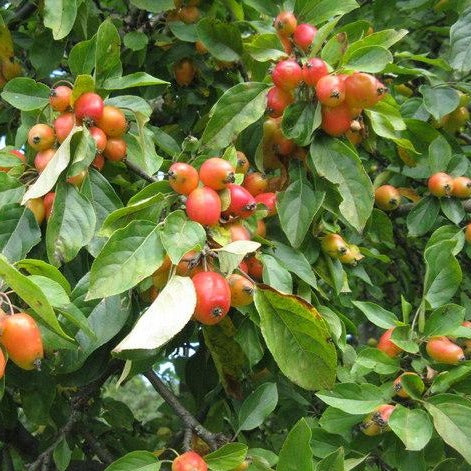
History: John Downie was raised by Edward Holmes, a nursery worker in England, in the 1870s. The variety was named after another nursery worker and friend of Holmes, John Downie. John Downie crabapples remain one of the most popular of the English crabapples.
Why We Grow It: This crabapple sports bright orangey-red fruit, often used to create some of the best jelly around. With its sweet-tart flavour, this crabapple can be pressed into a cheery orange juice that is a great addition to cider blends.

History: Hewe's Virginia (aka Hughes' Virginia or Virginia) was discovered in Virginia in 1817 although the first trees discovered were thought to be around 100 years old. It is believed that Hewe's Virginia is a cross between a European apple and a North American crabapple. It became quite popular for its excellence as a cider apple and was favoured by Thomas Jefferson who devoted an entire block of his orchard at Monticello to just Hewe's Virginia. This variety was widely planted in the 18th and 19th centuries but waned as interest in cider-making declined. Luckily, it stuck around with us due to its usage as rootstock and pollinizers for other varieties. With the growing popularity of cider in the US, however, Hewe's Virginia is making a strong comeback as people are once again realizing its potential.
Why We Grow It: This hardy, vigorous tree produces a good number of crabapples that are excellent for cider. It is easy to see why this variety was so popular back in the day and is making a resurgence now, the bittersharp juice is great on its own and in blends. Hewe's Virginia is also great for making jelly!

History: Rhode Island Greening emerged around 1650 where it was grown from seed by a Mr. Green near Green's End, Rhode Island. Mr. Green owned a tavern and often gave scions from the original tree to his customers, although the tree eventually died from the demand for scionwood. The name was originally the descriptive 'Green's Inn apple from Rhode Island' and later shortened to 'Rhode Island Greening.'* This apple was commonly grown in New York and is still quite common today.
*Fun fact: The Ontario ghost town Unopark got its name in a similar way. It was originally founded by Richard Parker, Mouse's ancestor, and the name is a shortened version of 'You know the Parkers?'
Why We Grow It: This apple's long-lasting popularity is due to its reputation as perhaps the definitive American pie-making apple. The large, dark-green apple is too tart to be eaten fresh but is great in pies and holds its shape well when cooked. It also produces nicely in our test orchard, producing large, blemish-free fruit despite it's generally poor disease resistance.

History: Harry Masters Jersey was discovered in the early 1900s at Yarlington Mill (in England) and is thought to be a seedling of Yarlington Mill (the apple variety). It was named after Mr. Masters, a worker at the mill who is thought to have discovered the apple.
Why We Grow It: Although not the most vigorous of apple trees, the fruit itself boasts a medium-full bittersweet juice of vintage quality with low acid that makes it popular among cider connoisseurs. Harry Masters Jersey also starts producing fruit at a young age.

Why We Grow It: Purple Passion produces a large apple with reddish-purple skin and crimson flesh. The flavour is quite sharp, making it better suited for cooking and especially cider. This juicy apple can be pressed into a crimson cider that is visually quite appealing. The tree also boasts attractive pink blossoms and red-tinged foliage, making it a nice ornamental tree as well.
Showing 120/181
Next