All Fruit Trees

All Fruit Trees
Looking for bareroot fruit trees Canada? We offer a wide variety of bareroot fruit trees including apples, apricots, pears, plums, cherries, quince, and peaches that are grown for the Canadian climate & we deliver cold-hardy fruit trees right to your door!
We also offer fruit trees for small gardens, heritage apples Ontario and you can filter all our fruit trees by hardiness zones. Search trees by collection or peruse all the varieties we carry below! We offer flat rate shipping across Canada.




320 products
Sort by:
320 products
320 products

History: Lodi is a cross between Yellow Transparent and Montgomery Sweet created at the New York Agricultural Experiment Station in Geneva, NY, and released in 1924. Although it is not suitable for commercial production due to its poor keeping qualities and tendency for the flesh to crack in storage, it is still commonly grown by homeowners in the southern US today.
Why We Grow It: If you're looking for an early apple to get started on making applesauce, Lodi is the way to go! These large yellow-green apples are ready to harvest by the end of July and do not bruise as easily as their Yellow Transparent parent.

History: Luna (translated from Latin as "moon") comes from a cross between Golden Delicious and Topaz. It was bred in 1999 by Dr. Jaroslav Tupý at the Institute of Experimental Botany in Prague in the Czech Republic. The variety was likely selected for its excellent flavour, storage capabilities, and disease resistance. It was released in 2006.
Why We Grow It: Luna produces a medium to large yellow apple that bears a strong resemblance to its parent, Golden Delicious. Like Golden Delicious, it is a sweet fresh eating apple that is firm and crisp. It can last in storage for about six months and the flavour is said to be at its best after about three weeks in storage. Luna also boasts good disease resistance and tendency to start producing fruit at a young age.
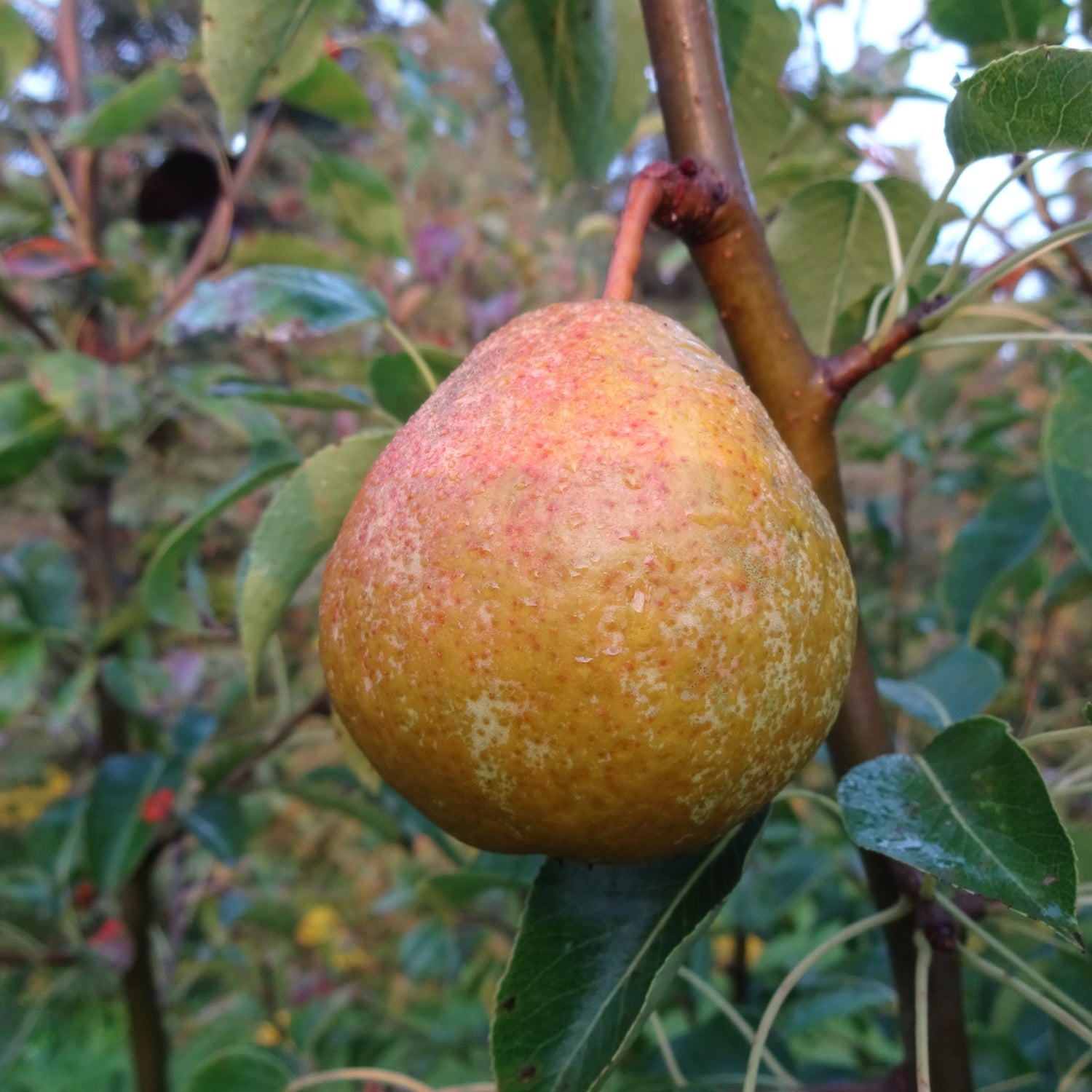
History: Luscious was developed at South Dakota State University as a cross between Ewark and South Dakota 31 in 1954. This goal was to create trees suitable for areas like the Northern Great Plains. Luscious was introduced in 1973, likely selected for its cold-hardiness and excellent flavour.
Why We Grow It: Luscious produces small to medium yellow fruits with an attractive red blush. The fruit is quite sweet, great for fresh eating and cooking/baking! This is an excellent option for fans of Bartlett who are looking for a versatile and cold hardy variety! Luscious also has value as an ornamental tree, producing white blooms and glossy green leaves that turn a nice red in the fall.

History: Maiden's Blush was first described in New Jersey in 1817 although it had already been popular in Philadelphia markets for some time. It likely originated around New Jersey in the late 1700s. Maiden's Blush continued to be commonly grown in the southern US through the early 1800s.
Why We Grow It: Maiden's Blush's uniqueness is still worthy of attention today, its flavour being an interesting mix of citrus-like acidity and sweetness that stand out among other apples. While it is good for fresh eating, particularly after a few weeks off the tree, it is most well known for cooking, baking, and drying due to its non-browning qualities.

History: Major dates back to potentially before the nineteenth century and was commonly grown on farms in Devon and Somerset in England. It remains a traditional English cider variety.
Why We Grow It: Major produces a lovely bittersweet juice that is good both in blends or on its own. It ripens relatively early so it is a nice apple for extending the cider pressing season.

History: Makamik is one of many Rosybloom crabapples developed by Isabella Preston at the Canadian Department of Agriculture Central Experimental Farm in Ottawa. She bred them with the goal of creating cold hardy, ornamental trees for harsher Canadian climates. Like the other crabapples in the series, Makamik is named after a Canadian lake. It was released in the 1920s or 1930s and remains a popular ornamental crabapple to this day.
Why We Grow It: Makamik is a very cold hardy and disease resistant crabapple valued for its ornamental appeal. Sporting pink blooms and leaves with a reddish tinge, it makes a lovely addition whether you're looking for visual appeal, a pollination partner for your other apple trees, or a food source for your local birds in the winter!


History: While on vacation on Manitoulin Island in 2022, Wayne Kuntze found Manitowaning Pink Heart growing wild in the corner of the Gulyas family's yard and (with permission) brought the apples and some grafting material back to Silver Creek Nursery. The distinct pink colour and the heart shape of the fruit caught his eye, along with the pink flesh inside. Fittingly, he named it Manitowaning Pink Heart after the village where the property was located and the unique appearance of the apple. A truly unique variety, we are happy to officially introduce it in 2023!
Why We Grow It: We love unusual apple varieties and Manitowaning Pink Heart really stands out! With its attractive pink blush over yellow skin, pink flesh, and heart-shaped fruit, this is a one of a kind apple! Despite its sweet appearance, this crabapple is quite tart and tannic. Like other crabapples, this one is best suited for jelly and cider. Its pink flesh may help add a distinctive colouration.
This is a brand new variety and we're still learning about it! For any avid apple growers who decide to plant these out, feel free to keep us updated on how it grows, what you use the fruit for, etc, so we can provide as much information as possible!
Bloom photo courtesy of Christine Gulyas
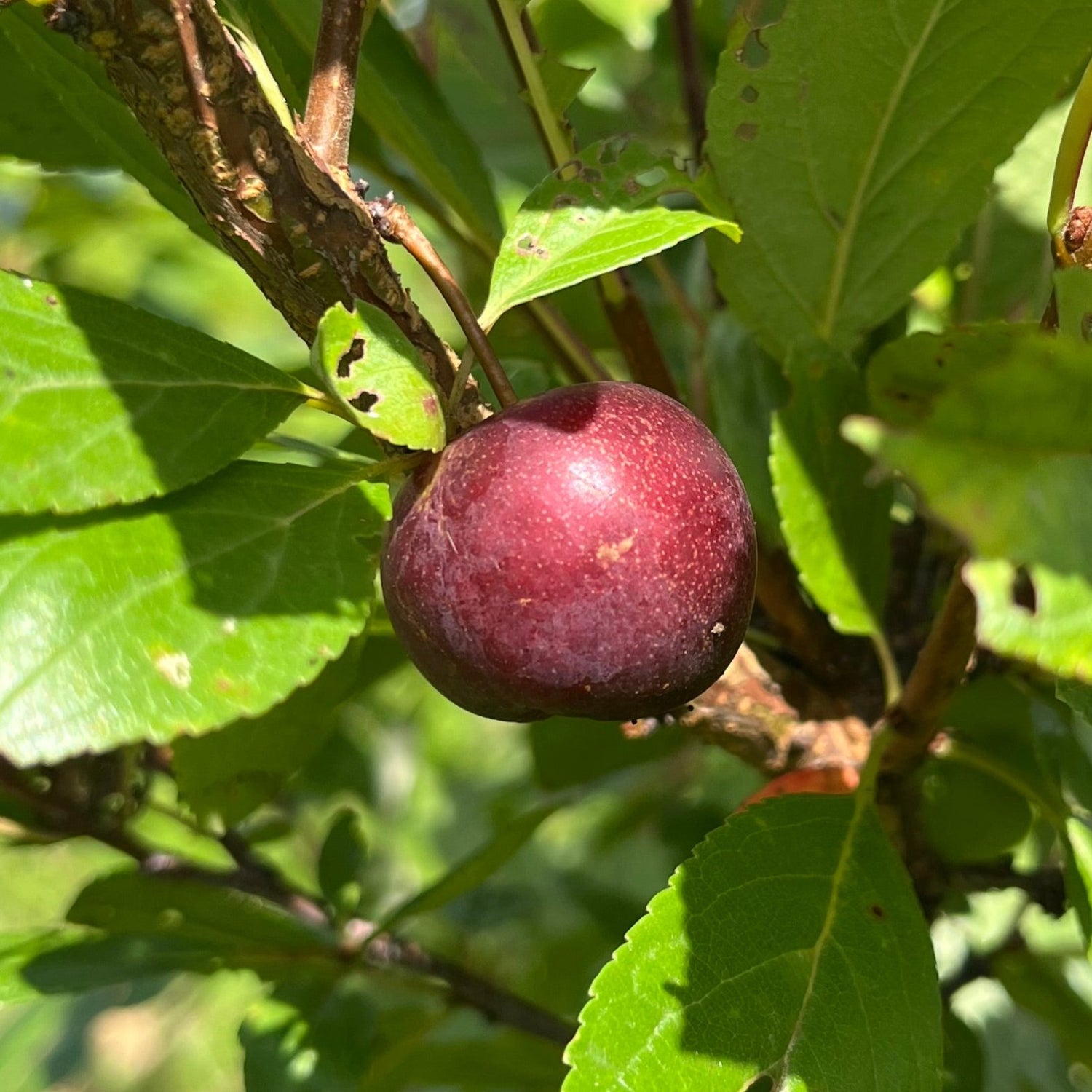
Species: Prunus pumila var. besseyi (Western sandcherry) x P. salicina (Japanese Plum)
History: Manor was developed at the Morden Research Station in Manitoba and released in 1945.
Why We Grow It: Manor produces a small plum with skin that is nearly black when ripe and purplish-red flesh. When ripe, the fruit is quite sweet and good for fresh eating! Some prefer to pick it when it is still a little unripe and a bit firmer since it is more astringent and lends itself well to uses such as baking, preserving, and making wine. The shrub stays smaller than other chums but starts bearing fruit at a young age and is known for being quite productive.

History: Little to nothing is known about this apple other than it likely originated in France.
Why We Grow It: Astringent! First apple to produce in Ken's orchard planted 2019 in Beaver Valley. Despite its foggy past, this apple has a lot of potential for a bright future. It produces an aromatic juice and is quite high in tannins, making it a great addition to cider blends. The tree is known for its vigorous growth (notable compared to cider trees in general), high productivity, and general disease resistance which make it definitely worth growing.
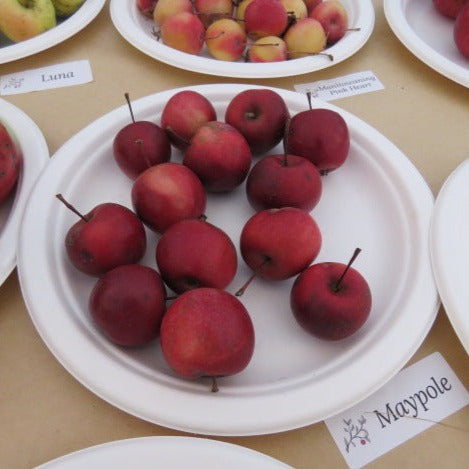
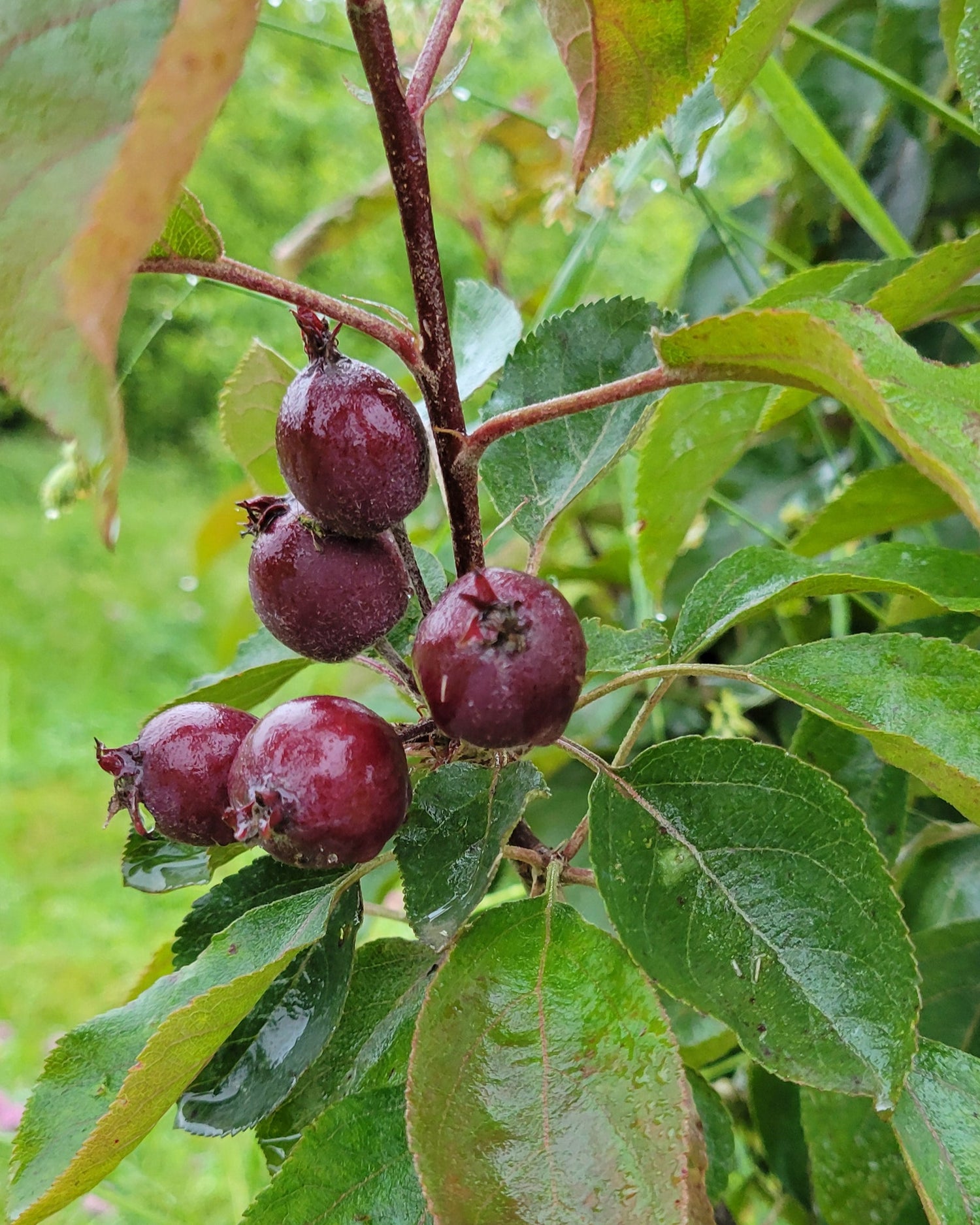
History: Maypole was developed in 1976 by Plant Breeding International at the East Malling Research Station in the UK as a cross between Wijcik Spur McIntosh and Baskatong. Wijcik Spur McIntosh originated as a mutation discovered on a McIntosh tree in 1962 in the Wijcik Orchards in British Columbia, the branch growing oddly straight with little branching. Several varieties were deliberately bred to have this mutation and now Maypole, released in 1986, is one of six columnar varieties developed at the station. This series of trees is known as Ballerina in the UK but due to that name being unavailable in the US, they are known as Colonnade in North America.
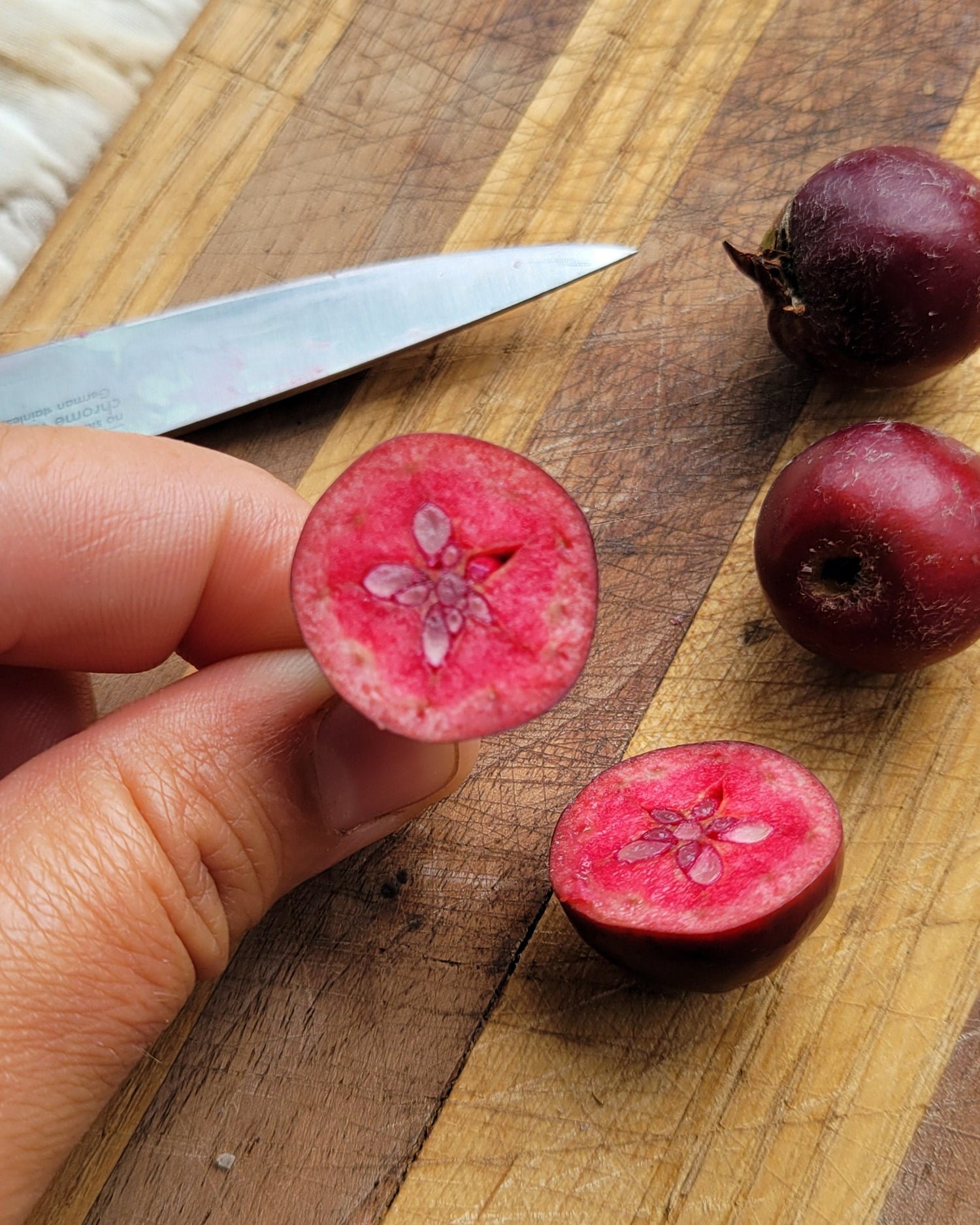
Why We Grow It: Not only is Maypole unique as a columnar apple, this crabapple also boasts lovely red flesh, bronze coloured leaves, and pretty pink blossoms in the spring. This makes it overall a lovely ornamental tree to have, whether planted in the yard or in a pot. The fruit is also excellent for jelly, apple butter, and cider, adding a red hue to each. It can also be eaten fresh although it tends to be quite acidic with a touch of sweetness.

History: John McIntosh planted several apple seedlings upon settling in Dundela, Ontario. From these, he discovered the famous McIntosh apple as a seedling in his orchard. The family began selling the fruit and grafted McIntosh trees in 1835 and in 1870 it entered commercial production. By the 1900s it was one of the most popular apples in northeastern North America, although its popularity waned over time as varieties such as Gala were introduced. Nonetheless, McIntosh apples still remain some of the most popular in North America. The original tree died in 1906 after being damaged by a house fire and a commemorative plaque marks where it stood. The apple has since been named Canada's national fruit. The Macintosh line of Apple computers was also named after this variety.
Why We Grow It: For fans of Canadian heritage apples in particular, this one is hard to beat. To the best of our knowledge, this is the original strain of McIntosh. Aside from its storied past, McIntosh apples boast soft, slightly tart flesh with high Vitamin C content. It is excellent for fresh eating and making applesauce.

History: Medaille d'Or was raised from a seed by Monsieur Goddard in Rouen, France. In 1873 the apple was awarded a gold medal by the Societe Centrale D’Horticulture de Departement de la Seine Inferieure and in 1884 was brought to England by the Woolhope Naturalist's Field Club where it became established as a classic English cider apple.
Why We Grow It: It is easy to see why this apple was popular in both France and England with its yellow-gold skin and excellent cider qualities. This apple produces a fruity juice with high alcohol content and is very high in tannins. It makes a great single-variety cider.

History: Meigetsu is an Asian pear that originated in Japan. The word 'meigetsu' roughly translates to 'beautiful moon' or 'grand moon.' Its name could also be a shortened version of 'Chushu no Meigetsu,' the Japanese name for the harvest moon in September.
Why We Grow It: Meigetsu Asian pears are pleasantly sweet with the flavour and aroma being compared to pineapples, watermelon, and butterscotch. The flesh is somewhat softer than other Asian pears, making the texture more akin to that of European pears.

History: Melba was developed by W.T. Macoun at the Central Experimental Farm in Ottawa in 1898. In 1924 it was released commercially and three years later received the Silver Wilder Medal from the American Pomological Society.
Why We Grow It: Melba is a lovely early market apple or backyard tree for making applesauce! The fruit is yellow with crimson flush and the crisp, white skin has a very sweet flavour.

Why We Grow It: Melrose produces a flattish apple that has greenish skin overlaid with a bright red flush. It is firm, juicy, and sweet with a more acidic flavour that improves after a little while in storage. It is great for both fresh eating and cooking and can be stored for several months. The tree itself starts to bear at a young age and produces heavy crops, although it has a tendency to bear fruit every other year.
Showing 180/320
Next