In-Stock Inventory

In-Stock Inventory
Make your selections faster and easier by shopping "In-Stock" items only.
We offer flat rate shipping across Canada for our bareroot trees!
308 products
Sort by:
308 products
308 products
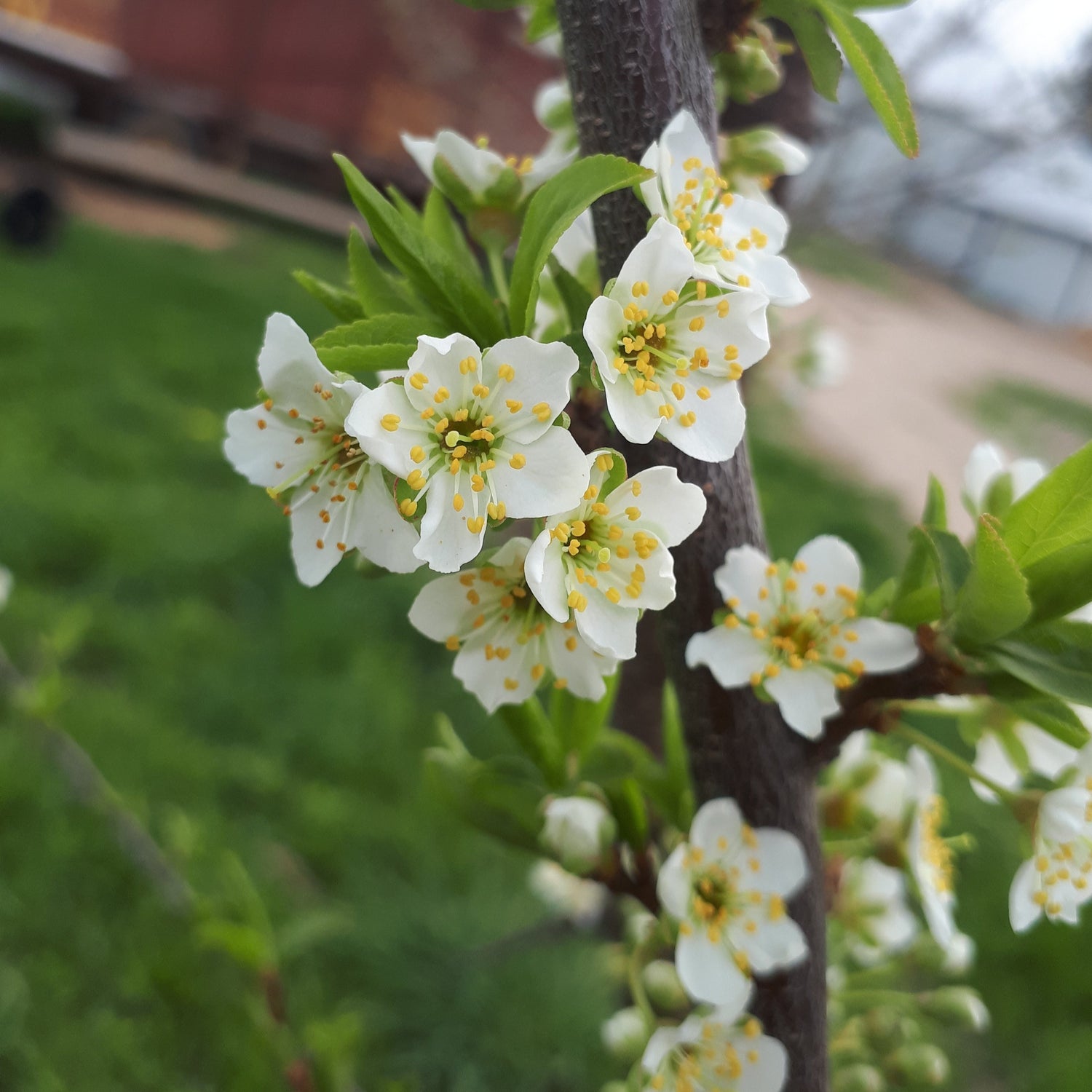
Species: Prunus sp
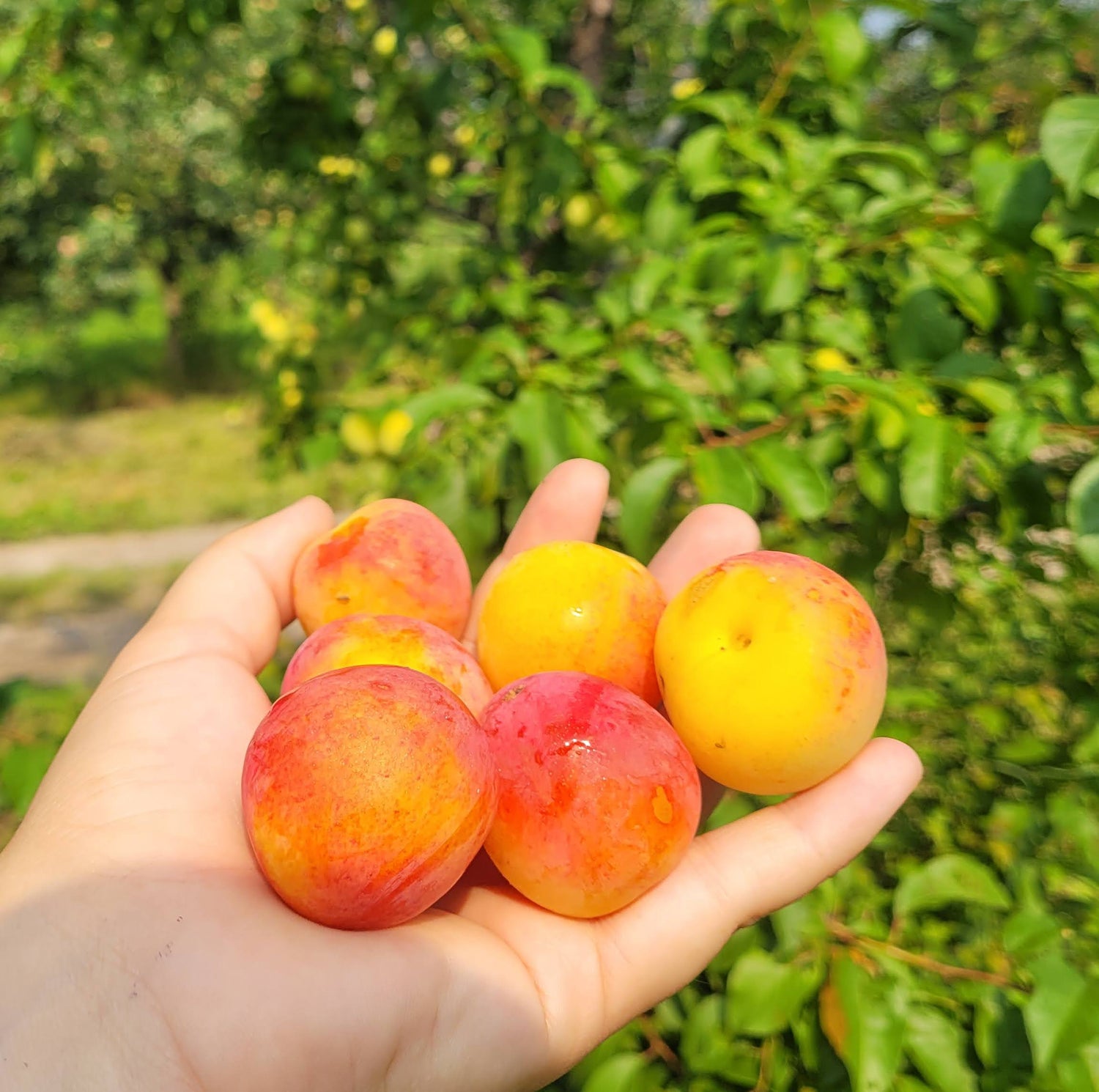
History: These seedlings are grown from Early Golden plum seeds collected in our orchard. The parent variety, Early Golden, was discovered in Fonthill, Ontario and it has since become the most popular yellow plum in Ontario.
Why We Grow It: Seedling fruit trees are a great way to add some diversity and mystery to your garden or orchard! The parent variety, Early Golden, produces medium-sized fruit that is very sweet with tangy yellow skin that gets a cheery red blush where the sun hits it. It also has a low susceptibility to black knot which, with any luck, the seedlings will have inherited!
Please Note: Since plums tend to stay true to type more than apples, these seedlings will likely bear a strong resemblance to their parent variety. However, any specific information listed on this page should be taken with a grain of salt as there may be some variation from the parent tree.

History: Cutie Pie was developed at the University of Saskatchewan using Mongolian cherry material donated by plant breeder Les Kerr who first created the dwarf sour cherry bushes. It was selected for its compact size, good flavour, and extreme cold hardiness and released as part of the university's 100 Years of Horticulture Celebrations in 2021.
Why We Grow It: Cutie Pie is a compact plant, even compared to the other dwarf sour cherry bushes. Only reaching about 4ft tall once mature, this is a great option for those with limited space. The small, red cherries have a more balanced sweet/tart flavour so they are great for eating fresh and using in baking or cooking! It is a reliable and productive variety.
Check our our blog post with some tasty sour cherry recipes!

History: D'Artagnan was developed by the University of Saskatchewan and shares the same parents as several varieties in the Romance series. It was bred for and selected due to its suckering habit which makes it suitable to form a cold-hardy fruit-bearing hedge. D'Artagnan is the fourth variety released in the Musketeer series and was named for the fourth musketeer in The Three Musketeers. It was released in 2021 as part of the university's 100 Years of Horticulture Celebrations.
Why We Grow It: D'Artagnan produces dark red cherries similar in flavour to Juliet. Like Juliet, it can be eaten fresh or used for cooking and baking. Its main feature, however, is its tendency to sucker heavily which makes it suitable for forming hedges. If individual d'Artagnan bushes are planted 1m apart, they will eventually fill in to form an edible hedge. For those in colder climate areas especially, this can be a unique addition to an edible landscape!
Check our our blog post with some tasty sour cherry recipes!

Species: Lonicera caerulea
History: Chito was created by Dr. Maxine Thompson who collected open-pollinated seeds from berry farms in Hokkaido, Japan in 2000. The seeds were planted in Oregon and evaluated. Chito was selected in 2014 for its open growth habit, vigour, yield, and fruit quality.
Why We Grow It: Chito produces a large, sweet/tart, ovate berry with a milder flavour than other haskaps. Like other haskaps they are good for fresh eating, baking, and making jam/jelly. This vigorous shrub has a more open growth habit than other varieties, making the fruit easier to see and harvest.


FELCO 512 - Budding & Grafting Knife

Trees are our allies in healing the world. Partnering with trees allows us to build soil, enhance biodiversity, increase wildlife populations, grow food and medicine, and pull carbon out of the atmosphere, sequestering it in the soil.
Trees of Power explains how we can work with these arboreal allies, specifically focusing on propagation, planting, and individual species. Author Akiva Silver is an enthusiastic tree grower with years of experience running his own commercial nursery. In this book he clearly explains the most important concepts necessary for success with perennial woody plants.


History: Valentine was developed at the University of Saskatchewan and released in 2002 as part of the Romance series. Valentine stands out amongst the Romance series as having the reddest fruit and the highest vigour.
Why We Grow It: Valentine produces tart bright red cherries that are great for drying due to their colour. They are also excellent for baking, especially if you love cherry pie! If you prefer a sour flavour, pick the cherries as soon as they turn red on the bush. Otherwise, wait a week or so until the colour deepens and they will be a bit sweeter. Valentine gets taller than some of the other dwarf sour cherry bushes but has higher overall yields as a result.
Check our our blog post with some tasty sour cherry recipes!


Species: Prunus pumila var. besseyi (Western sandcherry) x P. salicina (Japanese Plum)
History: Opata was developed by Dr. N.E. Hansen who was a professor of horticulture at South Dakota State University from 1895 to 1950. He helped pioneer chum development in an effort to create plants hardy enough to survive in the northern prairies. Opata is the Sioux word for 'bouquet', following Hansen's tradition of naming his native plant crosses after words from local indigenous cultures.
Why We Grow It: Opata produces a red chum with yellow flesh that is freestone, firm, juicy, and considered to be one of the better tasting chums. It is pleasantly sweet with only a hint of acidity. It is good for fresh eating as well as jams, jellies, preserves, and pies. Like other chums, the shrub itself is compact, cold hardy, and relatively free of pests and disease.

History: Big Red was developed by Bob Bors at the University of Saskatchewan. It was one of several varieties an American company further evaluated in the US and selected as the best amongst them. Chosen for its notable cold hardiness, large size, and unique shape along with its good flavour, Big Red is sold under the name Wowza! in the US. The variety is still considered experimental since the original tree was accidentally destroyed prematurely.
Why We Grow It: Along with having good flavour, Big Red is most notable for its large size: the fruit can be twice as big as other dwarf sour cherries! The fruit is also uniquely elongated with a lobed end, giving it an appearance akin to Red Delicious apples. In trials at the University of Saskatchewan, the variety suffered no winterkill so it appears to be extremely cold hardy even in comparison to other dwarf sour cherries. The only downside to this variety is that it has lower yields than other varieties, perhaps as a tradeoff for its other traits.
Check our our blog post with some tasty sour cherry recipes!

Species: Actinidia arguta
History: There appears to be little information available on the origin of Opitz. It has likely been propagated for its late bloom time, making it compatible with some female varieties that are not pollinated by earlier blooming male varieties.
Why We Grow It: Opitz is a later blooming male variety that is helpful for pollinating late blooming female Hardy Kiwis like Anna and Chang Bai. It grows vigorously and is known to flower profusely.

Species: Lonicera caerulea
History: Kawai was created by Dr. Maxine Thompson who collected open-pollinated seeds from berry farms in Hokkaido, Japan in 2000. The seeds were planted in Oregon and evaluated. Kawai was selected for its fruit quality, high yields, and high vigour.
Why We Grow It: Kawai produces medium, blocky berries with an excellent, mild flavour. Like other haskaps, the fruit is well suited for fresh eating, baking, and making jelly/jam among many other uses. The cold hardy bush itself is quite vigorous and has high yields.

History: Shinseiki (translated from Japanese as 'new century') was developed in Japan and released in the 1940s. It is a cross between Chojuro and Nijiseiki.
Why We Grow It: Shinseiki is known for producing large harvests of round, yellow-green pears with a pleasant crunch early in the season. They have a mild, sweet flavour but can bruise easily due to their high juice content. The fruit hangs onto the tree well and the flavour improves over time.


Mesto - 3558 - 18L Backpack Sprayer with Added Adjustable Nozzle
User-friendly backpack sprayer for professional use with internal piston pump for the highest level of user protection, offering the best wearing comfort due to padded S-shape straps as well as hip belt, pump lever that can be changed right/left, pump lever length and width adjustment, extra large filler opening, cover with loss protection and integrated measuring cups, ergonomic shut-off valve with integrated pressure gauge and filter, 50 cm brass spray wand with brass nozzle, 18 l fill capacity, FPM seals, made in Germany, guaranteed 20-year availability of MESTO spare parts.
Ideal for: Professional garden centers, care for gardens with large trees, forestry, care for espalier trees. The added adjustable nozzle is so you can get to the top of your semi-dwarf trees - tested by Silver Creek Nursery!


This honey is pure, unadulterated goodness from my hives. I (Jodi, the beekeeper) harvest honey with care each season when the bees have enough extra to share. Each season the local terroir influences the flavours captured in my jars of liquid gold, although often there are similar flowers and farmers crops, such as alfalfa, clovers, sunflowers, and more that the bees visit every year.
This year I took a small harvest at the end of July and a final harvest at the end of August. The honey from the 2nd harvest had a small amount of basswood honey which I kept separate! Basswood honey has a unique flavour that can be described as waxy, buttery, metallic, and sometimes minty, depending on your palate. I find it to be a bit metallic with buttery/waxy notes that sometimes reminds me of buttery popcorn, and it's one of my absolute favourite Ontario honeys.
The rest of the season's harvest is a delicious summer blossom/wildflower honey.
- I harvest my honey with a no-heat process. It is cold extracted and then I bottle it up before it has a chance to crystallize.
- When freshly harvested (usually late July or August) this honey is in its liquid state and will slowly crystallize over time.
- Depending on the time of year ordered, it may come to you crystallized (my favourite as it's easier to scoop out!), partially crystallized, or liquid. You can always return honey to it's liquid state with a hot water bath, repeating and stirring to help dissolve crystals if needed. I used to re-heat jars to keep them liquid, but I'd rather sell pure raw honey and will only be doing it upon request.
- Natural crystallization is sometimes fine-grained and can be quite similar to creamed honey, but without the manual labour (or machine) that is typically used to create creamed honey.
Why does honey crystallize? Honey is made by the bees, who collect nectar from flowers. The nectar is naturally about 80% water and sugars, most of which are sucrose. The bees use their own special enzymes to break down the sucrose into fructose and glucose - the same types of sugars found in apples and other fruits and vegetables. This helps make honey a naturally healthy sweetener because our bodies recognize it quickly and both fructose and glucose are smaller sized molecules of sugar which our bodies can digest easily. But where does the crystallization come in? Right here: Glucose naturally prefers to form a crystalline structure, so over time it separates and builds itself into crystals within your jar of honey!
There is nothing wrong with honey that has gotten crystallized and it is perfectly safe to eat. However, if you prefer it liquid, you can gently heat your honey to cause the glucose' crystalline structure to dissolve back into a liquid state. Over-heating honey can destroy healthy enzymes, so it is recommended to heat no hotter than your hand can stand. My go-to method is to boil water in a kettle or saucepan, remove from heat, and place my jar into it. Allow to cool, stir and repeat if your jar is quite crystallized.


Crafted with love and apple-y aplomb by Jodi at Huckleberry Hives! Jodi thought it would be fitting to honor this old apple in candle form so she made a mold using a real lady apple from Silver Creek Nursery!
- pure beeswax candle, colours created with candle dye
- candle size: 3.8cm wide by 2.5cm tall (1.5" x 1")
- approximate burn time 15 hours
🍎The Lady apple is synonymous with holidays and has a long history of use for decorating trees (ornaments or garlands) as well as use in wreath making.
🍎It is also known as Pomme d'Api - the oldest recognized apple variety under that name - originally documented during early Rome under Etruscan rule, around 700BC!!
🍎The first time it was called Lady was during the French Renaissance in 1628, and it became naturalized in America during the 1800's.
These candles can also be purchased with specialty greeting tags for teacher gifts, romantic gifts or wedding favours:
- "I'd apple-y be in your class forever."
- "You are the apple of my eye."
- "I'd apple-y be yours forever."
- "Appley ever after."

In The Home-Scale Forest Garden, Baker shares what she learned as she became a forest gardener, providing a practical, in-depth guide to creating a beautiful, bountiful edible landscape at any scale—from a few dozen square feet to an acre or more.
Baker provides information on planning, planting, and maintaining a resilient forest garden ecosystem, including:
- Using permaculture principles
- Observing and mapping your space
- Building planting beds, including hügelkultur mounds
- Coping with saturated soil
- Matching perennial edible plants to the right growing conditions
- Grouping plants in diverse layers that attract and shelter beneficial insects and birds
- Creating microclimates to increase the range of plants you can grow
- Pruning, propagating, managing pests, and more
- Expending less energy for greater reward
The Home-Scale Forest Garden is complete with descriptions of over 100 food-bearing and multifunctional plants for every layer of a forest garden: overstory and understory trees, shrubs, herbaceous plants, groundcovers, vines, and mushrooms, too.

For decades fruit growers have sprayed their trees with toxic chemicals in an attempt to control a range of insect and fungal pests. Yet it is possible to grow apples responsibly, by applying the intuitive knowledge of our great-grandparents with the fruits of modern scientific research and innovation.
Since The Apple Grower first appeared in 1998, orchardist Michael Phillips has continued his research with apples, which have been called "organic's final frontier." In this new edition of his widely acclaimed work, Phillips delves even deeper into the mysteries of growing good fruit with minimal inputs.


Species: Lonicera caerulea
History: Tundra was developed at the University of Saskatchewan and released in 2010. It was selected for its large size, good flavour, and, perhaps most importantly, its firmness. The large, firm berries made the variety well-suited for commercial growing and harvesting.
Why We Grow It: Tundra produces large, elongated berries with a sweet and tangy flavour. The berries are firmer than other varieties which makes them a great option for mechanical harvesting in larger scale operations. Despite the firmness, they still have a pleasant texture and are great for all the usual haskap uses such as fresh eating, baking, or preserving.

Note: Our Evans sour cherries are grown from cuttings so they will be smaller and bushier than the grafted and seedling sour cherries we offer. Please see 'Size at Purchase' below for more details!
History: Evans (aka Bali) was originally grown by a Mrs. Borward living near Fort Saskatchewan, Alberta. This was quite notable since, at the time, it was believed that it was impossible to grow any cherry trees in the prairies! She had been growing the cherries since the early 1920s and the cold hardy tree was eventually brought to the attention of horticulturalist Dr. Ieuan Evans by a friend. In 1976, her garden was slated for destruction due to the pending construction of a federal prison so she invited Dr. Evans to take suckers to propagate the tree. He gave the suckers out to a wide circle of friends and acquaintances who were all impressed and the variety was dubbed 'Evans' in his honour by another Alberta Agriculture horticulturalist. Dr. Evans tried to bring the variety to the attention of local nurseries who turned it down, refusing to believe cherries would grow in the cold prairie climate. Eventually, it was picked up by nurseries and Evans became the number one selling cherry tree in North America.
Why We Grow It: Evans produces bright red cherries that are excellent for pies, jellies, jams, and juice. This naturally dwarfing variety only reaches about 12-14ft tall compared to to a full-size tree which can reach up to 25ft. Evans tends to grow as more of a bush but can be pruned to maintain a tree form. It produces a profusion of white blooms in the spring which makes it quite attractive as an ornamental plant as well.
Check our our blog post with some tasty sour cherry recipes!

Species: Vitis sp. (hybrid)
History: Frontenac was bred by renowned cold hardy grape breeder Elmer Swenson at the University of Minnesota. It was released in 1996 and since then has become commonly planted in Canada and northeastern America where other wine grapes will not perform as well.
Why We Grow It: Frontenac produces a blue grape that is best used for wine-making. It is suitable for rosés, dry red wines, and fortified wines such as port. It is high in both acidity and sugar, producing a balanced wine with a nice colour.

History: Scarlet Vivian was originally an urban wild tree found by Wayne in 2018 and has been grown by Silver Creek Nursery's previous owner Ken Roth. It is likely a cross between a crabapple and an apple. We are excited to introduce this new variety in 2023!
Why We Grow It: Scarlet Vivian is quite similar to Dolgo although a little larger. For those who like very tart apples, this is an excellent one for fresh eating! The flavour is rich and complex, but balanced enough that it is quite enjoyable. However, Scarlet Vivian is best made into a jelly where its red colouration really shines. It may also have potential in cider blends. Based on Ken's observations, the tree appears to be relatively free of pest and disease issues.

Gypsum is a common hydrated calcium sulfate mineral. One of its benefits comes from its ability to break up heavy, compacted clay soils, as it can effectively change the soil structure of soils that have been compacted due to flooding, over cropping and heavy traffic. It has the ability to penetrate the millions of fine clay particles in heavy or hardpan type soils and loosen the soil structure. This process then creates air and moisture spaces that eventually loosen and break-up the soil structure. The only problem is that this doesn't happen overnight, it takes yearly applications, over about a three-year period to get the job done. For most home gardeners however, reducing compaction and improving aeration is better accomplished by the application of an organic mulch in nearly any landscape.
Gypsum is neutral and does not change the soil pH, thus making it useful for adding calcium without moving your ph of the soil. However it is also valuable for reducing excess sodium in soils. Excess sodium can interfere with nutrient as well as water uptake in the plants.
Lime and gypsum are not equal. Lime is calcium carbonate, while gypsum is calcium sulfate. Gypsum will add calcium to your soil without moving the ph while lime will move your ph upwards. As gypsum is more soluble than lime, it's calcium will become available more quickly to your plants. Careful however, as excess calcium levels in your soil can tie up the magnesium uptake, even when the magnesium levels are high.
Application
In calcium deficient soils, use at a rate of 1 pound for 10 sq ft of soil surface 1-3 times a year.
This is a very high grade gypsum that we bring in because it is a consistent fine grind, and consequently excellent for drip irrigation.
Equivalency Measurement - 7 cups/2kg
Owen adds "Hey so I got some of your gypsum in and just did some testing. at 1 tbsp per 5 gal that works out to about 3 grams per Gal. The EC was about 1.0. for flush this ratio would work fine I'd even go as low as 2 g per Gal.
For just an addition of calcium into your feed I'd say even 1 gram per gallon. I'm going to come back to you around end of May and see how my flush does.
This is just a reference for anyone coming to you guys using rockwool and possibly needed some suggestions this may help them out."

Wool Pellets Soil Conditioner - Bethel Farm
Wool pellets are a natural, eco-friendly soil conditioner that improves moisture retention, promotes healthy plant growth, and reduces the need for chemical fertilizers. They help repel pests, regulate temperature, and break down over time to enhance soil health—making them a sustainable choice for any garden or house plant.
Key Benefits:
-
- Improves moisture retention around roots
- Reduces transplant shock
- Encourages deeper, stronger root systems
- Provides slow-release nitrogen over time
- Fully natural, biodegradable, and soil-building
To learn more about Bethel Farm (Julie raises happy sheep and produces quality lamb): visit Bethel Farm website.
To learn more about how to use pellets: visit Gezellige Farm website.

